A waste product that carries information
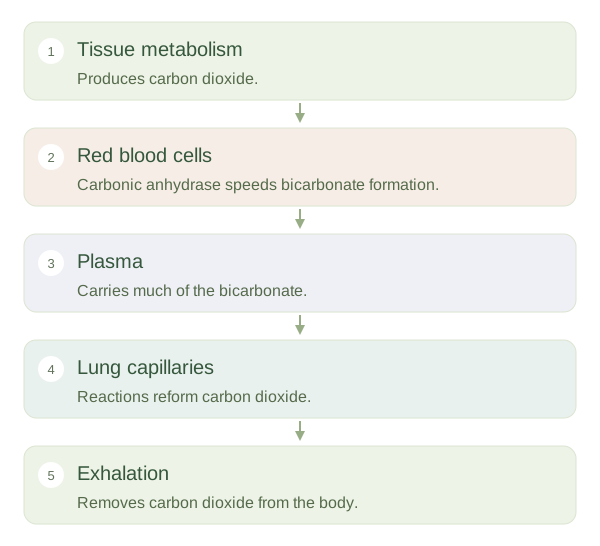
Cells produce carbon dioxide as they extract energy from nutrients. It diffuses into blood and travels to the lungs. Some remains dissolved, and some attaches to proteins including haemoglobin. Most is converted into , a dissolved ion. This is more than a disposal route: the chemistry of carbon dioxide and bicarbonate is closely connected with blood pH, so breathing also helps regulate acidity.
Most carbon dioxide travels as bicarbonate and is removed through the lungs.
 Open diagram larger ↗
A reversible chemical shuttle
Inside red blood cells, the enzyme speeds the reaction between carbon dioxide and water. The resulting chemistry produces hydrogen ions and . Haemoglobin helps the hydrogen ions, while much of the bicarbonate moves into plasma. In lung capillaries, the process reverses. Bicarbonate and hydrogen ions are used to reform carbon dioxide, which diffuses into alveoli and is breathed out. The same reversible reactions can therefore collect carbon dioxide at tissues and release it at the lungs without needing to transport it all as dissolved gas.
Ventilation changes carbon dioxide balance
If falls relative to carbon dioxide production, arterial carbon dioxide rises. This tends to lower pH. If ventilation increases substantially relative to production, carbon dioxide falls and pH tends to rise. These relationships explain why breathing changes can create respiratory acid–base disturbances. The kidneys also regulate and acid excretion, but their responses generally develop more slowly than respiratory adjustments. Carbon dioxide is therefore neither merely toxic waste nor an unlimited benefit: its concentration is tightly regulated. Holding your breath allows it to accumulate and helps generate the urge to breathe. During exercise, increased carbon dioxide production is normally matched by increased ventilation, so blood chemistry need not change dramatically. Useful interpretation always compares production, transport and removal rather than breathing rate alone.