Breaths have different sizes
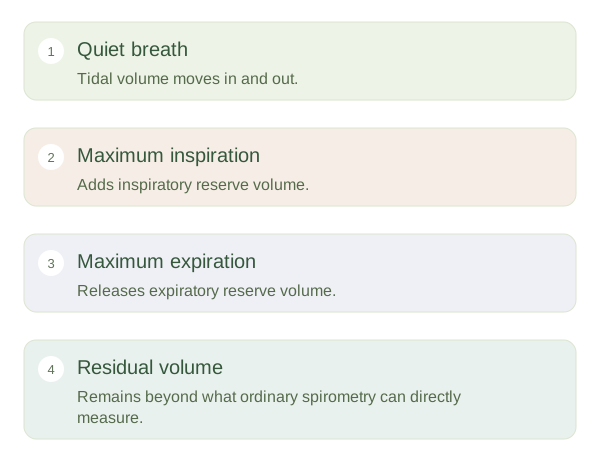
is the air moved during an ordinary quiet breath. You can inhale additional air beyond that normal inspiration; this is inspiratory reserve volume. You can also force out additional air after an ordinary expiration; this is expiratory reserve volume. Even after the strongest possible expiration, some air remains in the lungs. This helps describe the lungs as structures that do not normally empty completely with every breath.
Spirometry measures moving air, not every volume remaining in the lungs.
 Open diagram larger ↗
Volumes combine into capacities
is the maximum air that can be exhaled after a maximal inspiration. It combines with the inspiratory and expiratory reserves. Total lung capacity includes vital capacity plus . The relationships are useful, but expected values vary with factors such as height, age and sex-related physiology. A single universal normal number would therefore be misleading. The important starting point is understanding which air can be moved and which remains after maximal expiration.
What a breathing test reveals
During spirometry, a person breathes through a device that records airflow and volume. A forced manoeuvre measures forced , or FVC, and the volume exhaled in the first second, or . When airways are obstructed, exhalation often becomes slower and the FEV1/FVC ratio falls. A reduced FVC may suggest restriction, but spirometry alone does not confirm a restrictive disorder; total lung capacity must be assessed using additional techniques. Ordinary spirometry cannot directly measure because that air never leaves through the measuring device. Results also depend on a reliable technique and suitable reference values. Spirometry is therefore a carefully performed measurement interpreted alongside clinical information. It is not simply a competition to blow the largest number, nor does it directly measure how much oxygen reaches tissues.