A specialised communication cell
A is a nerve cell adapted to receive and transmit information. Its cell body contains the nucleus and much of the machinery needed to keep the cell alive. Branching processes called dendrites provide a large surface for receiving signals. These structures are not interchangeable wires: their shapes and membrane proteins help determine how information is handled. Neurons vary greatly, but a typical neuron combines many incoming influences before producing its own outgoing signal.
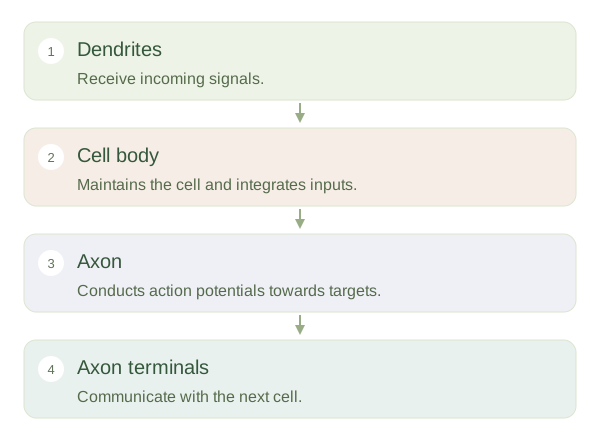
A neuron receives many inputs and sends signals along its axon.
 Open diagram larger ↗
From local input to travelling signal
Inputs often change the electrical voltage across small regions of the membrane. Some make an outgoing signal more likely; others make it less likely. Near the beginning of the , these influences are integrated. If the appropriate threshold is reached, an action potential travels along the axon. The axon may be extremely short or extend a long distance, such as from the spinal cord towards a foot. It does not carry a packet of fluid from the cell body; the signal is a changing pattern of membrane voltage.
Connections make circuits
At terminals, a communicates with another neuron, a muscle cell or a gland. Most such contacts are chemical synapses, where neurotransmitter is released across a tiny gap. Many axons are wrapped in made by supporting cells. Myelin allows signals to travel faster by concentrating regeneration of the electrical signal at gaps called nodes. A neuron therefore needs both specialised parts and a supportive environment. Damage to an axon can disrupt communication even if its target muscle is otherwise healthy. Understanding the basic layout helps explain why sensation, movement and thought can all use similar cellular machinery while depending on very different circuits and connections throughout the nervous system.