A voltage across a membrane
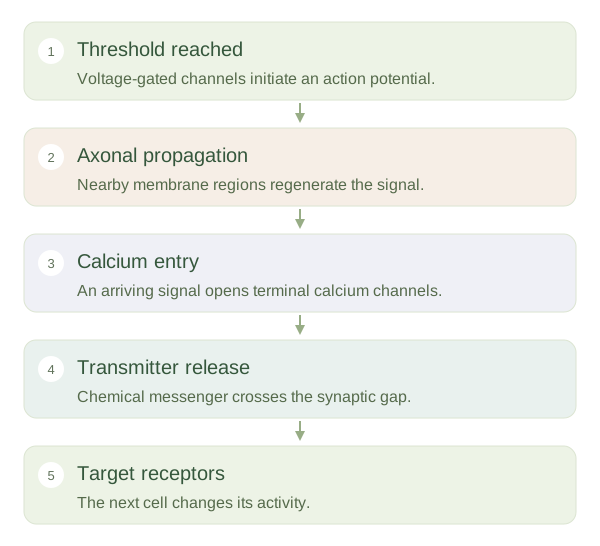
A resting neuron has unequal distributions of charged ions inside and outside its membrane. Channels and pumps help maintain these conditions. When stimulation reaches a sufficient , voltage-gated sodium channels open and sodium enters, making the inside temporarily less negative. Potassium channels then help restore the voltage. The resulting is a brief, regenerating electrical change. A stronger stimulus does not usually create a taller action potential; information can instead be represented by firing frequency and patterns across many cells.
Electrical signals travel along neurons; neurotransmitters connect most neurons.
 Open diagram larger ↗
A wave rather than a travelling object
An triggers the next region of membrane, which triggers the next. Individual ions move short distances across the membrane; they do not race from a finger all the way to the brain. Recently activated membrane has a refractory period, during which another action potential is impossible or harder to produce. This helps separate signals and supports normal propagation. Myelin speeds transmission by allowing current to spread between nodes where action potentials are regenerated.
Crossing the synaptic gap
At a typical chemical , the arriving opens calcium channels in the terminal. Calcium entry triggers release. The transmitter crosses a small gap and binds receptors on the next cell. Its effect depends on the receptor and target cell: it can increase or decrease the likelihood of another action potential. Neurotransmitter is then removed by breakdown, uptake or diffusion. Electrical and chemical stages therefore perform different jobs. The axon efficiently carries a signal over distance; the synapse allows selective, adjustable communication between cells. Changing synaptic strength is one way nervous circuits adapt with experience, while failed transmission can interrupt a signal even when the axon itself remains intact.