Neurons do not work alone
Glial cells are active partners in nervous tissue. Astrocytes help regulate the chemical environment around neurons, including extracellular potassium and transmitter levels. They support communication with blood vessels and contribute to the conditions needed for a healthy . Oligodendrocytes make myelin around axons in the central nervous system. Schwann cells provide myelin around peripheral axons. Microglia act as resident immune cells, responding to injury and clearing material. These roles overlap in a complex living network rather than forming isolated housekeeping services.
Glia support neural circuits, while selective barriers regulate their environment.
 Open diagram larger ↗
A selective border in capillaries
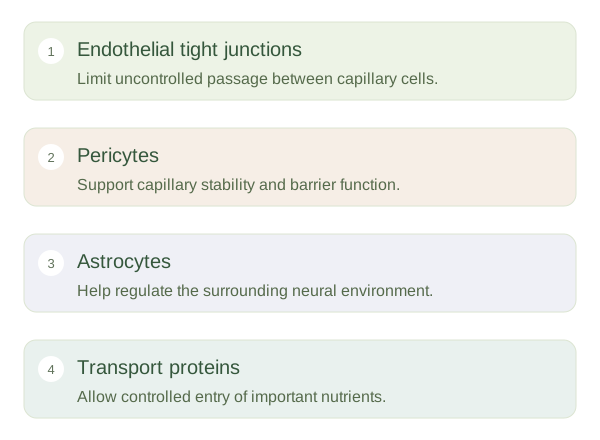
The is mainly created by tightly connected endothelial cells lining central nervous system capillaries. Supporting cells, including pericytes and astrocytes, help maintain its properties. The barrier limits uncontrolled movement of many substances from blood into brain tissue. It is selective, not absolute: oxygen and carbon dioxide pass readily, while glucose crosses through specialised transport systems. This protects electrical signalling from large fluctuations in blood chemistry without preventing the brain from receiving fuel.
Protection has practical consequences
The barrier makes some medicines less able to reach the brain. Conversely, inflammation or injury can disrupt its normal selectivity. Certain specialised brain regions have different barrier properties so they can monitor blood chemistry or release hormones. The barrier is therefore not a uniform wall surrounding every brain structure. Myelin and the barrier also solve different problems: myelin improves axonal conduction, while the barrier regulates the surrounding environment. Losing myelin can slow or block signals even if the remains intact. Understanding these distinctions prevents the misleading idea that all non-neuronal cells are just packing material. Reliable nervous function depends on support, insulation, immune regulation, nourishment and carefully controlled exchange with the circulation.