A different route from spinal nerves
Twelve pairs of cranial nerves are conventionally numbered I to XII. They connect with the brain rather than emerging as ordinary spinal nerves. Most are closely associated with the brainstem, although the olfactory and optic pathways have important differences. Cranial nerves are especially important for the head and neck, but the extends into the chest and abdomen. Their distribution therefore does not stop at the skull’s lower edge.
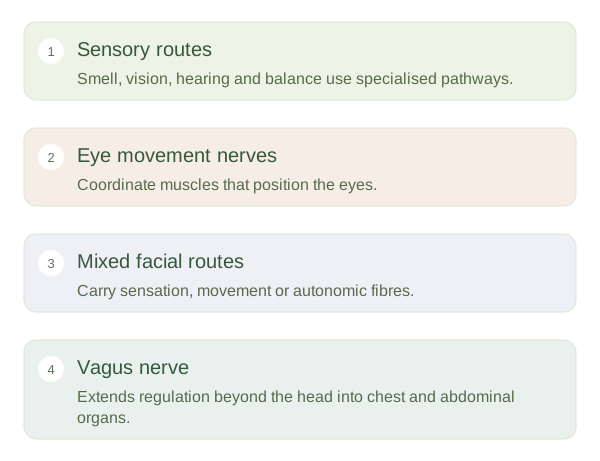
Cranial nerves connect the brain with specialised sensory and motor functions.
 Open diagram larger ↗
Sensation, movement and internal control
Some cranial nerves are predominantly sensory: olfactory pathways carry smell, optic pathways carry vision, and the vestibulocochlear nerve carries hearing and balance information. Others mainly control muscles, including nerves moving the eyes or tongue. Several are mixed. The provides much facial sensation and supplies chewing muscles. The moves muscles of facial expression and also carries taste and parasympathetic functions. The vagus participates in swallowing and voice as well as parasympathetic control of many organs.
Patterns are more useful than a list alone
A single everyday task can recruit several nerves. Eating involves smell, taste, facial sensation, chewing, tongue movement and swallowing. Each depends on different connections. This explains why a problem affecting one nerve can produce a recognisable combination of changes. Clinical examination may compare eye movements, facial movements, sensation, hearing or tongue position, but a symptom alone does not identify a diagnosis. The same function can depend on central pathways, peripheral nerve fibres and the target organ. Initially, learn the broad groups and a few useful examples before memorising every number. The important concept is that cranial nerves are varied communication routes, some sensory, some motor and some mixed, with specific connections that let the brain interact with the face, special senses and internal organs.