Many fibres within one nerve
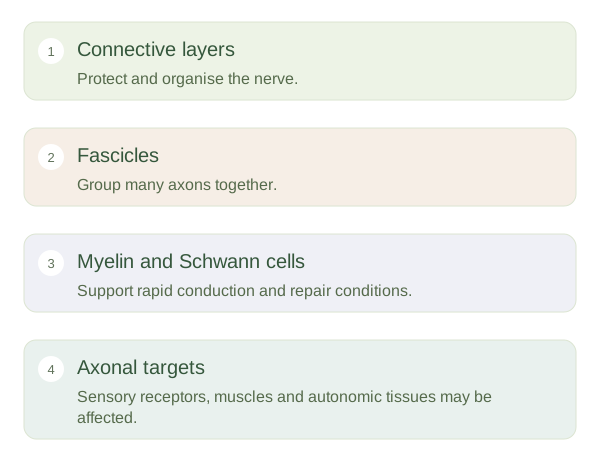
A contains bundles of axons supported by connective tissue and small blood vessels. These bundles are called fascicles. A single named nerve may include sensory fibres, motor fibres and autonomic fibres. The outer nerve is therefore more like a protected cable containing many lines than a single cell. Schwann cells support peripheral axons and form myelin around many of them. Both the axon and its supporting layers matter for reliable conduction.
Peripheral nerve damage can affect sensation, movement and autonomic function.
 Open diagram larger ↗
Different damage produces different effects
Compression may disturb blood supply or myelin and slow conduction. More severe injury can interrupt axons. Sensory fibre involvement may cause numbness, altered sensation or pain. Motor fibre involvement can weaken muscles supplied by that nerve. Autonomic changes can affect functions such as sweating. Symptoms often follow the nerve’s distribution, although overlapping supply and variations make patterns imperfect. This differs from a spinal root injury, which follows a different anatomical organisation and may involve fibres that later enter several peripheral nerves.
Repair has limits
Peripheral axons sometimes regrow if the cell body survives and the supporting pathway remains favourable. Recovery depends on injury type, distance to the target and many biological factors. A mildly compressed nerve is not equivalent to a completely severed nerve. Regrowth can be slow and incomplete, and fibres may not reconnect precisely. Central nervous system regeneration is generally much more limited, so peripheral and central injuries cannot be treated as identical. Understanding the structure explains why protecting a nerve’s blood supply, insulation and continuity all matter. It also explains why tingling alone does not tell us whether damage is temporary, permanent, local or part of a broader condition. The pattern, examination and appropriate investigations provide the context needed to interpret symptoms.