Detecting possible harm
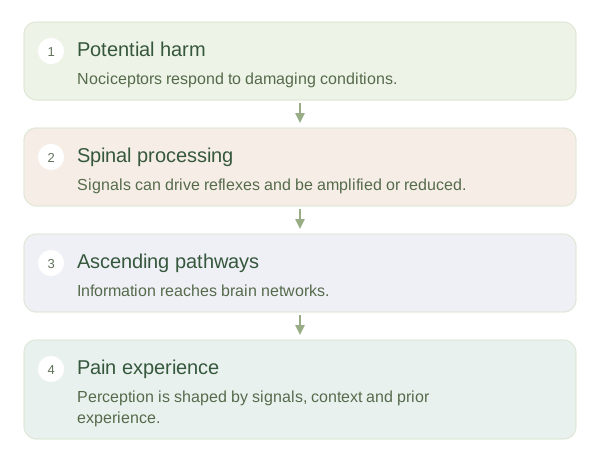
Nociceptors are sensory endings that respond to potentially damaging mechanical, thermal or chemical conditions. They convert such stimuli into neural activity. Signals enter the spinal cord and can contribute to withdrawal reflexes and ascending pathways. This process is called . Pain is the unpleasant sensory and emotional experience associated with actual or potential harm, and it is not identical to activity in a single receptor. You do not have a simple wire that measures tissue damage and displays its exact amount.
Pain is a real protective experience shaped by signals and nervous-system processing.
 Open diagram larger ↗
The signal can be adjusted
Spinal and brain circuits can amplify or reduce incoming information. Attention, expectation, past experiences, sleep and emotional state can influence pain. This does not make pain imaginary. It reflects the normal biology of a protective system that interprets information in context. Signals from the body remain important, but the relationship between pain intensity and tissue injury is not always proportional. A small injury can be very painful, and substantial injury can sometimes be noticed less immediately during an emergency.
Persistent pain has several mechanisms
Nociceptive pain is associated with activation of nociceptors by tissue injury or inflammation. arises from a lesion or disease affecting the somatosensory nervous system. Other persistent pain can involve altered processing without clear evidence of the tissue damage or nerve lesion that would explain it. These categories can overlap. means the system becomes more responsive, so ordinary inputs may feel more painful or pain may outlast initial healing. The useful lesson is neither to dismiss pain nor to assume it always proves continuing damage. Understanding its mechanisms helps explain why assessment considers nervous pathways, tissue health and broader context, rather than interpreting pain as a perfectly accurate damage meter.