Experience changes a living network
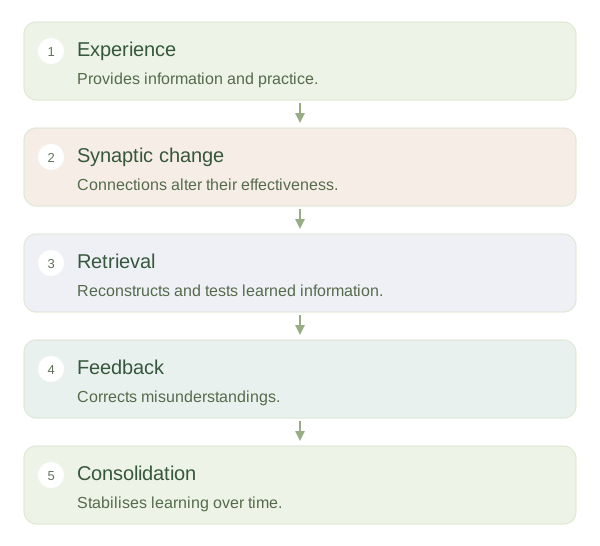
Learning is a change in knowledge, skill or behaviour resulting from experience. is the nervous system’s ability to change its structure or function. Synapses can become more or less effective, and networks can alter how they respond to repeated activity. This does not mean the brain is infinitely flexible or that every difficult task is solved by growing a new neuron. Much learning depends on changing existing connections and patterns of activity.
Learning changes connections; memory depends on several interacting systems.
 Open diagram larger ↗
Different memories use different systems
temporarily holds information available for a current task, such as remembering a number while entering it. Long-term memory includes knowledge, events and skills. The hippocampus is important for forming many new memories of facts and experiences, while long-term representations involve distributed cortical networks. Skills and habits depend strongly on other circuits, including basal nuclei and cerebellum. Remembering how to ride a bicycle is therefore not biologically identical to recalling the name of your first teacher.
Practice must retrieve and refine
Repeated exposure is not always the same as successful learning. Trying to retrieve an idea strengthens useful access to it, while feedback can correct an inaccurate model. Spacing practice gives the learner repeated opportunities to reconstruct information rather than simply recognising something just seen. Sleep contributes to memory and readiness to learn, although memory is not transferred into one single permanent storage box overnight. Plasticity also occurs after injury, when surviving circuits may reorganise, but recovery has limits and differs between people. The practical message is that short, repeated learning with understanding and feedback can build durable knowledge. A quiz is useful not only as a score: it can reveal which connections between ideas still need work and provide another opportunity to retrieve the concept.