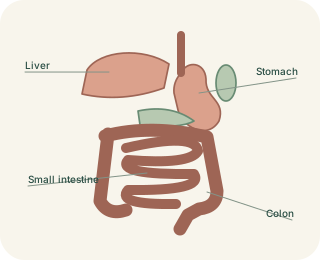
Preparation begins in the mouth
Chewing cuts and crushes food, increasing the surface available to digestive enzymes. Teeth provide different shapes for biting and grinding, while the tongue positions food between them. moistens and lubricates the material and contains substances including amylase, which begins starch digestion. Chewing does not complete chemical digestion. Its important immediate result is a manageable : a soft mass that can be moved safely towards the throat.
Swallowing coordinates food movement with temporary protection of breathing passages.
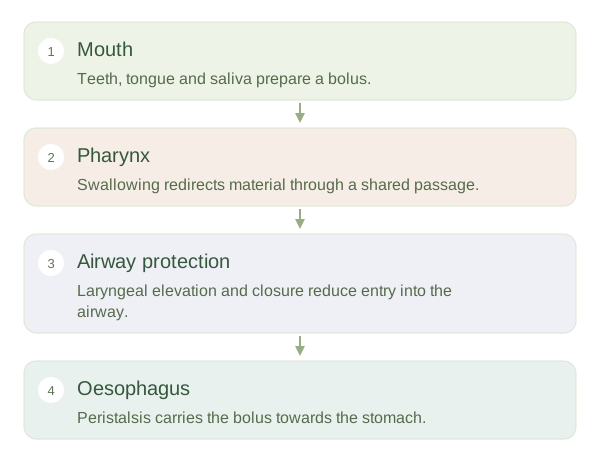 Open diagram larger ↗
A shared crossroads needs coordination
The pharynx carries both air and swallowed material, so swallowing must briefly redirect traffic. The tongue initially pushes the backwards. Sensory signals then trigger a coordinated swallowing sequence involving brainstem networks and several cranial nerves. The soft palate helps close the route towards the nasal cavity. The larynx elevates, vocal folds close and the epiglottis helps direct material away from the airway. Protection depends on several coordinated actions, not on one perfect lid acting alone.
Movement continues beyond conscious control
The upper oesophageal relaxes to allow entry into the oesophagus. Peristaltic contractions then carry the towards the stomach. Gravity may help when upright, but propulsion does not depend on gravity alone. Breathing pauses briefly during normal swallowing and then resumes. This coordination explains why talking or laughing with food in the mouth can interfere with a carefully timed sequence. means material enters the airway; it is different from material simply remaining in the throat or entering the oesophagus. Swallowing difficulty can arise from muscular, neurological or structural problems, so it cannot be reduced to a single cause. The central concept is cooperation: mechanical preparation, lubrication, sensory detection, neural timing and muscular protection all allow one shared passageway to serve eating and breathing.