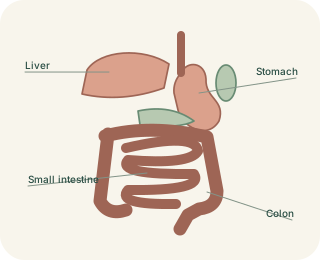
A muscular transport route
The runs from the pharynx through the thorax and diaphragm to the stomach. Its lining mainly protects against abrasion from swallowed material; it is not a major surface for nutrient absorption. Muscle composition changes along its length, with more skeletal muscle above and more smooth muscle below. Coordinated contractions carry swallowed contents downwards. A swallowed bolus stretches the wall, and additional peristaltic responses can help clear remaining material.
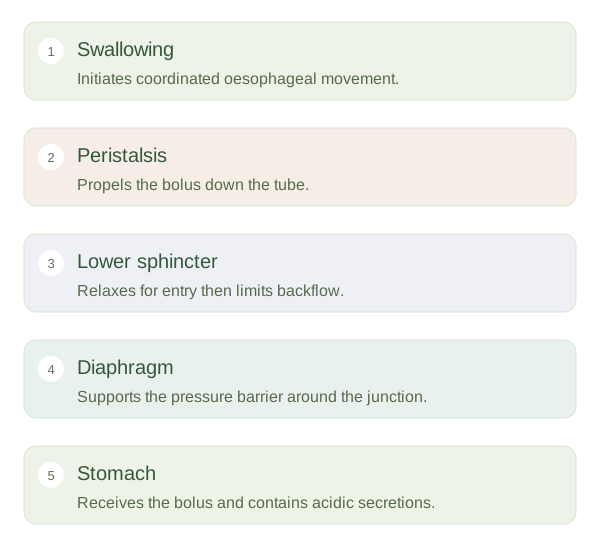
Peristalsis moves food down while the lower oesophageal region limits backflow.
 Open diagram larger ↗
Backflow faces several barriers
The stomach contains acid and digestive secretions that would irritate the oesophageal lining with repeated exposure. A high-pressure region at the lower end of the acts as a . It is a functional zone rather than a simple separate ring visible like a mechanical valve. The diaphragm around the oesophageal opening also supports this anti-reflux arrangement. During swallowing, the lower sphincter relaxes appropriately so food can enter the stomach, then normal barrier activity resumes.
Reflux is a relationship between pressure and protection
Some can occur in healthy people, particularly around meals. Gastro-oesophageal reflux disease involves reflux causing troublesome symptoms or complications. Increased abdominal pressure, altered sphincter behaviour or displacement of the junction in a can affect the balance. Symptoms alone do not describe every mechanism or prove a diagnosis. The stomach also has stronger protection against its own contents than the does. Understanding this difference explains why acid can be normal in one location and damaging in another. Think of the system as a transport tube with coordinated gates and pressure support. It must open to admit food, close enough to limit backflow and clear material that returns, rather than remaining permanently sealed.