Pressure starts urine formation
Blood reaches a glomerulus through an and leaves through an . Between them, capillary pressure pushes fluid towards Bowman’s space. The filtration barrier includes the capillary endothelium, a basement membrane and specialised cells called podocytes. Together, these layers normally restrict blood cells and most large proteins while allowing water and many small dissolved substances to cross. Filtration is therefore selective by physical and chemical properties, not by whether a substance is useful or unwanted.
Glomerular filtration moves small substances out of blood without selecting only waste.
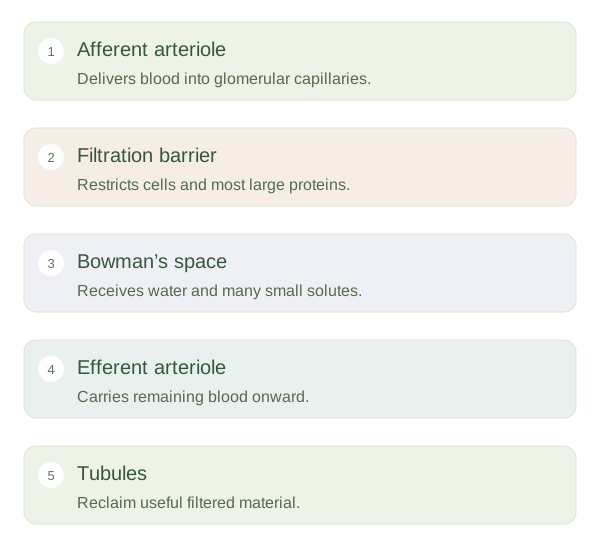 Open diagram larger ↗
Useful material is filtered too
Glucose, salts and other valuable small molecules normally enter filtrate. The tubules must then recover appropriate amounts. This explains why producing a large volume of filtrate does not mean producing the same large volume of urine. Most filtered water returns to the circulation. Glomerular filtration rate, or , describes the volume of filtrate formed by both kidneys per unit time. It is an important measure of filtration function, but it is not identical to urine output or a direct measurement of every kidney task.
Several forces must balance
Capillary pressure favours filtration, while pressure already present in Bowman’s space opposes it. Blood proteins remaining inside capillaries also draw water towards the circulation and oppose filtration. Changes in arteriolar tone, circulating volume or urinary obstruction can alter these forces. The kidneys use local regulatory mechanisms to limit excessive changes across a useful blood-pressure range, but protection is not unlimited. Severe reduction in perfusion can impair filtration. The key idea is a pressure-driven first separation followed by selective recovery. Thinking of the glomerulus as a device that recognises only toxins would miss why healthy tubular processing is just as necessary as an intact filtration barrier.