Two directions after filtration
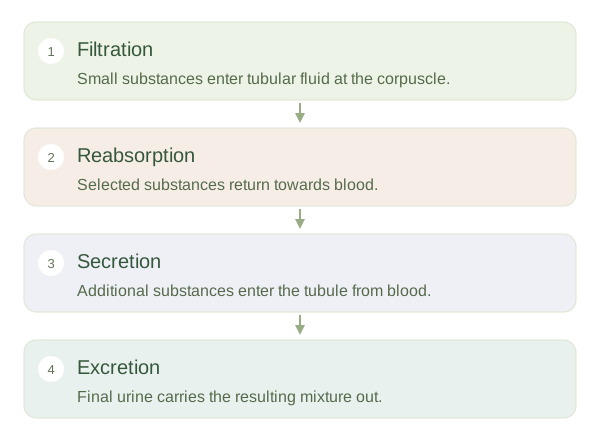
moves water or dissolved substances from tubular fluid back towards the blood. moves substances from blood or surrounding fluid into the tubule. These terms describe direction, not whether the substance is always good or bad. Sodium is often reabsorbed because it is needed for fluid and electrical balance, while some drugs and metabolic products are secreted to support excretion. Final urinary excretion reflects what was filtered, minus what was reabsorbed, plus what was secreted.
Reabsorption returns material to blood; secretion adds material to tubular fluid.
 Open diagram larger ↗
Transport requires specialised cells
Tubular epithelial cells have different surfaces facing the lumen and the surrounding tissue. Pumps and transport proteins move selected solutes across these surfaces. The sodium–potassium pump helps maintain gradients that indirectly drive much other transport. Glucose , for example, uses transport linked to sodium in the proximal tubule. Water often follows solute movement by where membranes are sufficiently permeable. This is controlled physiology, not simply particles falling through a sieve according to their weight.
Capacity and regulation matter
Transport systems have limits. If the filtered load of glucose exceeds the tubules’ reabsorptive capacity, glucose may remain in urine. Conversely, substantial water and salt recovery normally prevents the enormous filtered volume from being lost. Downstream segments adjust transport according to hormones and current needs, influencing sodium, potassium, acid and water balance. A molecule can be handled differently at different points, so its urinary concentration alone does not reveal every transport step. Understanding direction is the foundation: into blood means , into tubular fluid means . Combining these movements with filtration explains how kidneys can maintain the internal environment while removing substances that were not all eliminated by filtration alone.