The kidneys can change the final water loss
The body cannot simply stop producing urine whenever water is scarce, because wastes still need an excretion route. Instead, kidneys adjust how much water returns from tubular fluid to blood. Concentrated urine carries dissolved substances in less water; dilute urine carries them in more water. This flexibility depends on an internal concentration gradient, specialised nephron segments and hormonal control rather than on the bladder squeezing extra water out of stored urine.
A concentration gradient and adjustable water permeability help conserve water.
 Open diagram larger ↗
Building a concentrated medulla
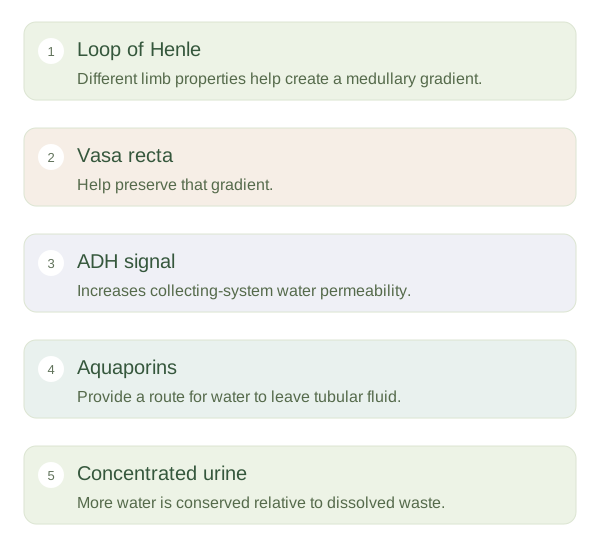
The loop of Henle has descending and ascending limbs with different properties. Water can leave much of the descending limb, while the thick ascending limb moves salt outward but is relatively impermeable to water. Their arrangement helps establish increasing solute concentration deeper in the medulla. Urea recycling also contributes, and specialised capillaries called help preserve the gradient while carrying reabsorbed material away. A gradient is therefore maintained by coordinated tubular and vascular organisation.
Opening a controlled water route
Antidiuretic hormone, also called vasopressin, increases water permeability in parts of the collecting system by promoting water channels. When is high, more water can leave tubular fluid down the medullary osmotic gradient, producing a smaller volume of more concentrated urine. When ADH is low, less water is recovered there and urine becomes more dilute. ADH is made in hypothalamic neurons and released from the posterior pituitary. Changes in body-fluid concentration and circulating volume influence its release. Water conservation therefore links brain sensing, hormonal communication and kidney anatomy. Even a strong hormonal signal cannot work normally if the gradient or collecting-system response is impaired, illustrating why the signal and the responding structures are both essential.