A controlled conversation
Hormone release usually changes according to the body's current conditions. is a control arrangement in which a response reduces the disturbance that started it. A thermostat is a useful comparison: heating reduces the temperature gap, so further heating becomes less necessary. In the body, the regulated condition may be blood glucose, calcium concentration or the level of another hormone. Negative does not mean harmful; it describes the direction of the feedback.
The thyroid feedback loop
 Open diagram larger ↗
Following the thyroid loop
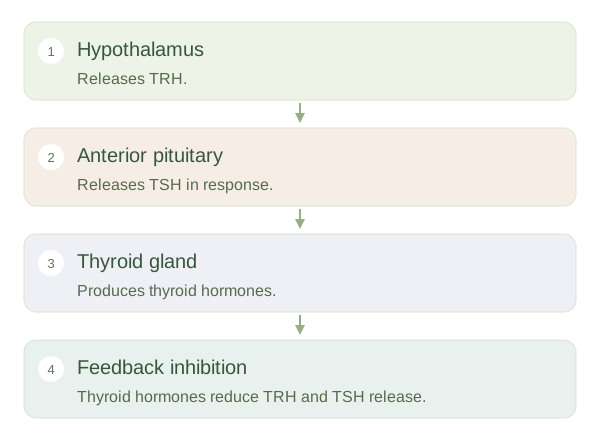
The hypothalamus releases thyrotropin-releasing hormone, or TRH. This stimulates the anterior pituitary to release thyroid-stimulating hormone, or . TSH encourages the thyroid to produce thyroid hormones. As sufficient thyroid hormone reaches the blood, it reduces further TRH and TSH release. The final product therefore sends information back towards the earlier control centres. If thyroid hormone falls, this inhibition decreases and the upstream signals can rise.
Why several levels help
A hormone chain provides several opportunities to adjust a response. The brain can integrate conditions such as stress, energy availability and daily rhythms before changing gland activity. Feedback also helps explain laboratory patterns. If the thyroid itself produces too little hormone, the pituitary may increase because feedback inhibition is weaker. This relationship is useful conceptually, but interpreting actual results also requires reference ranges, symptoms and clinical context.
The important exception
amplifies a response instead of opposing it. During established labour, cervical stretch contributes to oxytocin release, which strengthens contractions and can increase stretching. Such loops need an endpoint: birth removes the main stimulus. Neither feedback type guarantees perfectly constant levels. Hormones often fluctuate in pulses and daily patterns, so normal regulation means maintaining suitable conditions over time, not freezing every measurement at one value.