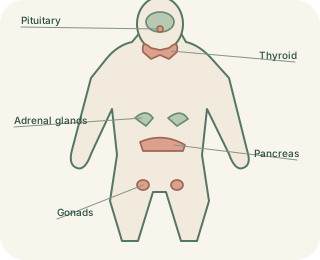
A gland at the front of the neck
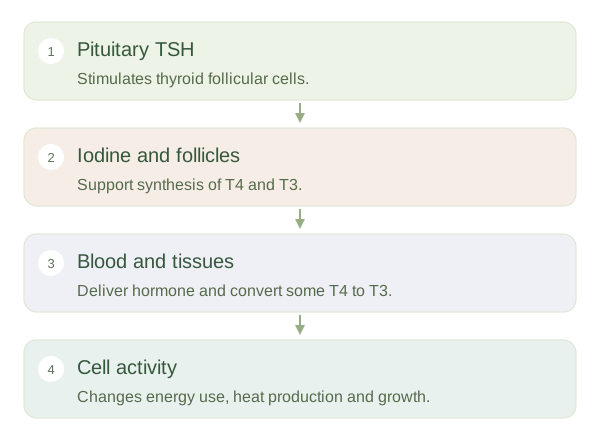
The thyroid has two main lobes joined across the front of the upper trachea. Its hormone-producing tissue is arranged in tiny follicles surrounding stored material called colloid. Follicular cells use iodine to make thyroxine, or , and triiodothyronine, or T3. Much circulating T3 is produced when other tissues convert T4. Most thyroid hormone travels attached to carrier proteins; a smaller free fraction is available to enter tissues.
Thyroid production and control
 Open diagram larger ↗
Adjusting the pace
Metabolism includes all the chemical reactions that maintain a cell. Thyroid hormones influence the expression of proteins involved in energy use, heat production and many other functions. They help regulate : the energy used to maintain essential processes at rest. Their effects are widespread, and normal levels are also important for growth and nervous-system development. They do not simply burn fat or act as an instant source of energy.
A feedback-controlled supply
The anterior pituitary releases thyroid-stimulating hormone, TSH, in response to hypothalamic signals. TSH encourages thyroid hormone synthesis and release. Rising thyroid hormone inhibits the earlier control signals through negative feedback. When the thyroid itself is underactive, TSH often rises as the pituitary tries to increase output. When the thyroid overproduces hormone, TSH is often suppressed. These patterns describe the basic loop rather than a complete guide to interpreting blood tests.
Why too much and too little matter
Too little thyroid hormone may slow several body processes, while too much may increase heat production and heart activity. Symptoms overlap with many other conditions, so no single symptom establishes a diagnosis. Another thyroid cell type, the C cell, makes calcitonin, a hormone involved in calcium regulation. This is a different role from that of T3 and , illustrating how one gland can contain more than one signalling system.