Preparing for a challenge
A stress response is the body's coordinated adjustment to a perceived challenge. The trigger may be physical, such as blood loss or strenuous activity, or psychological. Brain networks interpret the situation and influence autonomic nerves and endocrine signals. The purpose is not simply to create a feeling of worry: the response changes circulation, breathing, energy availability and attention to meet immediate demands.
Two coordinated stress pathways
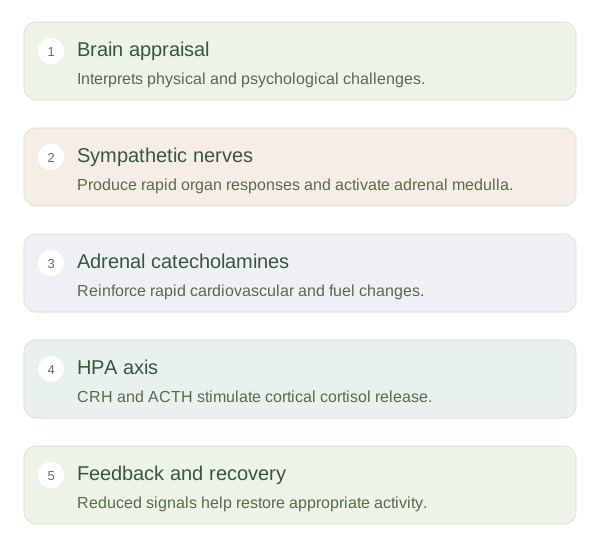 Open diagram larger ↗
The rapid sympathetic route
Sympathetic nerve activity can quickly increase heart activity and redistribute blood flow. It also stimulates the adrenal medulla to release adrenaline and noradrenaline. These hormones reinforce rapid changes, such as greater fuel availability and airway widening. The pattern varies between tissues because different receptors produce different responses. A racing heart before an important event is one familiar example, but it does not mean every organ becomes more active: digestive activity may decrease.
The cortisol route
The hypothalamus releases corticotropin-releasing hormone, CRH, which encourages pituitary release. ACTH stimulates the adrenal cortex to release cortisol. This is the hypothalamic–pituitary–adrenal, or HPA, axis. Cortisol influences fuel metabolism, supports the responsiveness of blood vessels and modifies inflammatory activity. It also feeds back to reduce earlier signals. Cortisol follows a normal daily rhythm as well, so its presence is not evidence of stress by itself.
Duration changes the meaning
Short-term activation can help maintain function during a challenge. Repeated or prolonged activation can have different consequences for sleep, metabolism, cardiovascular function and immune regulation. These effects are complex and vary between people; stress does not explain every symptom or illness. Recovery involves changing neural signals and restoring suitable activity, rather than permanently eliminating stress hormones. The key distinction is appropriate, regulated responses versus ongoing activation that no longer matches the body's needs.