Names describe structures
External genital anatomy includes tissues involved in protection, sensation, urination and sexual function. Common arrangements include a or a penis and scrotum, with considerable normal variation in size, shape, pigmentation and symmetry. Anatomical descriptions identify structures rather than defining gender identity. Some people also have variations in sex development or anatomy altered by medical care. A textbook illustration shows a useful pattern, not a standard that every body must match.
External structures and functions
 Open diagram larger ↗
The vulva
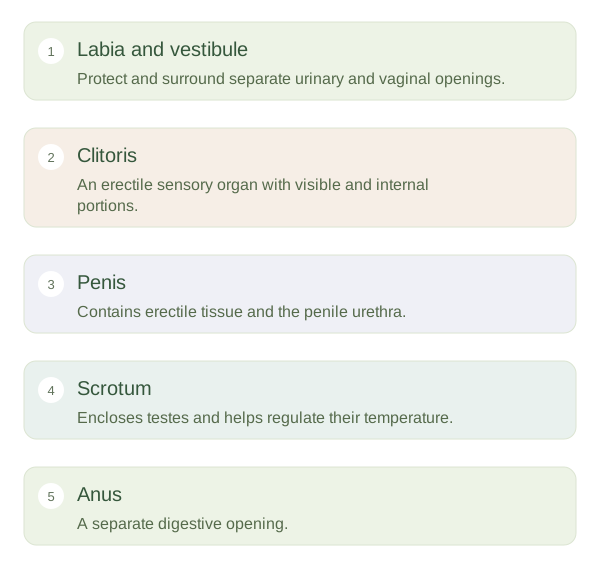
The is the collective term for external structures around the vaginal opening. The labia majora are outer folds, while the labia minora are inner folds that border the . The vestibule contains separate urethral and vaginal openings. The clitoral is the visible portion of a larger erectile organ whose body and crura extend internally. Vestibular bulbs are additional erectile tissues beside the vaginal opening. The vagina itself is an internal canal, so using vagina for all external structures obscures important distinctions.
The penis and scrotum
The penis contains two corpora cavernosa and a corpus spongiosum, erectile tissues that fill with blood during arousal. The corpus spongiosum surrounds the penile urethra and expands into the . A foreskin may cover the glans, depending on individual anatomy and circumcision. The scrotum encloses the testes and contributes to temperature regulation. The urethral opening provides an exit for urine and, during ejaculation, semen; these fluids originate from different systems.
Relationships that matter
The anus is a separate digestive opening behind the external genital region. The perineum includes the region between the thighs below the pelvic floor, with close relationships between genital, urinary and anal structures. Rich sensory nerves and blood vessels support normal function. Recognising the correct names makes it easier to communicate about anatomy and symptoms while respecting normal variation. Appearance alone cannot establish fertility, sexual experience or health.