Why reproductive cells are different
Most nucleated body cells contain two sets of chromosomes, usually forty-six in total. Gametes are reproductive cells with one set, usually twenty-three. is the specialised division that produces this reduction and reshuffles genetic information. When sperm and oocyte contributions combine at fertilisation, the usual two-set arrangement is restored. Without the reduction step, chromosome number would double with each generation.
Two routes to a gamete
 Open diagram larger ↗
Continuous sperm production
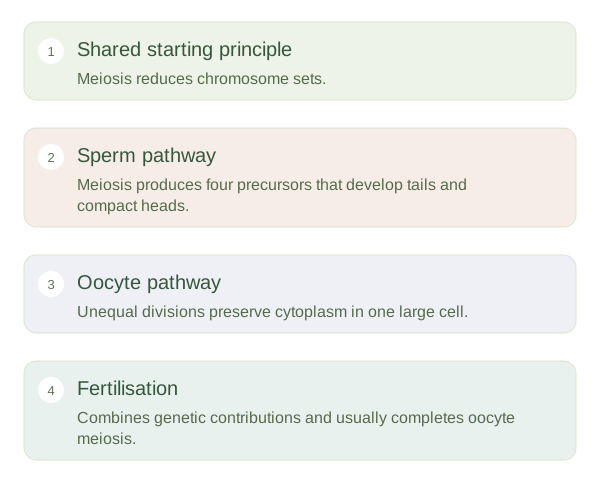
In the testes, precursor cells divide and enter within seminiferous tubules. One cell completing the meiotic divisions can give rise to four sperm precursors. These then undergo extensive shaping: genetic material becomes compacted in the head, a tail develops, and excess cytoplasm is removed. Supporting Sertoli cells help nourish and organise development. Starting around puberty, sperm production can continue throughout adult life, although quantity and quality may change with age and health.
A different ovarian timetable
Oocyte development begins before birth. Primary oocytes enter and then pause for years within follicles. In a typical ovulatory cycle, one developing oocyte completes the first meiotic division before ovulation. The division is unequal, preserving most cytoplasm in the large cell and placing little in a . The ovulated secondary oocyte pauses again and normally completes the second division only if fertilisation occurs. This is why the familiar word egg is useful but less precise than oocyte.
Different investments, shared purpose
A sperm is adapted for delivering genetic material, whereas an oocyte retains substantial cellular resources for early development. Neither is a complete miniature person. Hormones including FSH and LH regulate production through effects on gonadal cells. Both processes can be affected by genetic conditions, illness and environmental exposures. The comparison is about reproductive-cell biology; it does not imply that every person with testes or ovaries has the same fertility or developmental history.