Two cycles running together
An ovarian cycle describes follicle development, and activity. A menstrual or uterine cycle describes changes in the endometrium. Hormones coordinate the two. Day one is conventionally the first day of menstrual bleeding. A twenty-eight-day diagram is a teaching example, not a rule: cycle length and ovulation timing vary, especially across life stages. Ovulation does not reliably occur on day fourteen in every person.
Coordinating ovary and uterus
 Open diagram larger ↗
Building towards ovulation
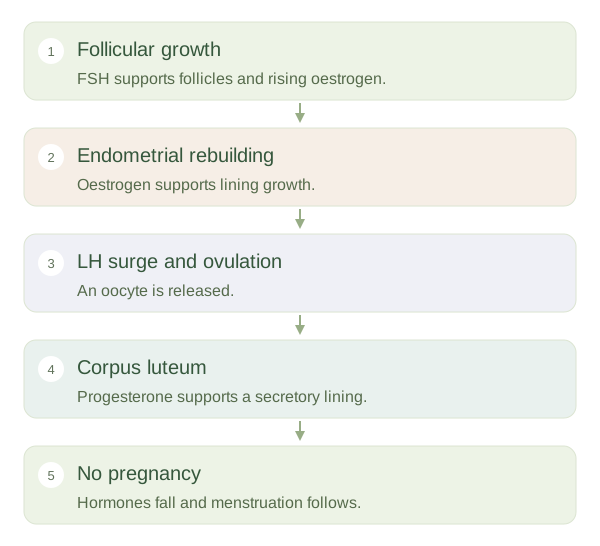
FSH supports follicular development in the ovary. A developing dominant follicle releases increasing oestrogen, which helps rebuild the endometrium after menstruation. For much of the cycle, ovarian hormones limit FSH and LH through negative feedback. Sustained high oestrogen near changes the feedback pattern and contributes to a surge of LH. This surge triggers the events leading to ovulation, when an oocyte is released from its follicle.
After the release
The remaining follicular tissue becomes the . It releases and oestrogens, supporting a secretory endometrium prepared for possible implantation. Progesterone is particularly important in this stage. If pregnancy does not occur, the corpus luteum normally degenerates. Falling hormone levels lead to breakdown and shedding of part of the endometrium, producing menstruation. The entire uterine wall is not lost: a deeper basal layer remains to help rebuild the lining.
If implantation occurs
An implanting embryo produces , which supports the during early pregnancy until placental hormone production becomes sufficient. This maintains hormonal support for the uterine lining. Not every menstrual bleed proves that occurred, and cycle patterns can be influenced by illness, hormonal contraception and other factors. Understanding the linked mechanisms is more useful than memorising one calendar, particularly because biological variability makes calendar-only predictions uncertain.