More than one body pathway
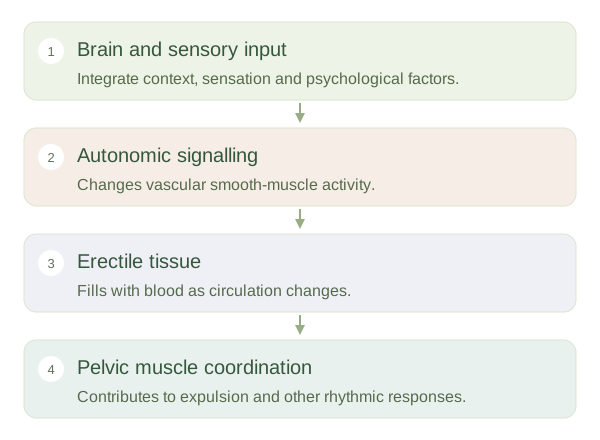
Sexual arousal involves brain activity, sensory input, emotions, autonomic nerves and changes in blood flow. The pattern varies between people and situations. A physical response does not establish desire, consent or enjoyment; these cannot be inferred from genital blood flow. Anatomy helps explain mechanisms while recognising that sexual experience is influenced by relationships, health, medication and many other factors.
Coordinated components of arousal
 Open diagram larger ↗
Erectile tissue and circulation
Erectile tissues contain vascular spaces that can fill with blood. During an erection, neural signals promote smooth-muscle relaxation and increased blood inflow. is an important local messenger in this process. In the penis, expansion also reduces venous outflow, helping retain blood. The clitoris and vestibular bulbs also contain erectile tissue. Genital and lubrication contribute to sexual responses, although lubrication involves multiple sources and differs with hormonal and individual conditions.
Coordinated transport and muscles
In a common ejaculatory sequence, moves sperm and glandular secretions towards the urethra through smooth-muscle activity. Expulsion then involves rhythmic contractions of muscles, including pelvic-floor muscles. Sympathetic and somatic pathways make important contributions, while erection is strongly associated with parasympathetic and local vascular signalling. These are useful broad distinctions, but the full response is more integrated than an absolute rule assigning each event to a single nerve division.
Function varies
Orgasm is a subjective and neurological event that often accompanies rhythmic muscular responses, but it is not identical to ejaculation. Fertility also cannot be inferred simply from arousal or orgasm. Sensory nerves, hormones and vascular health can all influence function, and changes may arise through several interacting mechanisms. Understanding the physiology explains why reproductive structures do not act independently: circulation, the nervous system and pelvic support work together, with substantial normal variation in timing and response.