An exchange organ
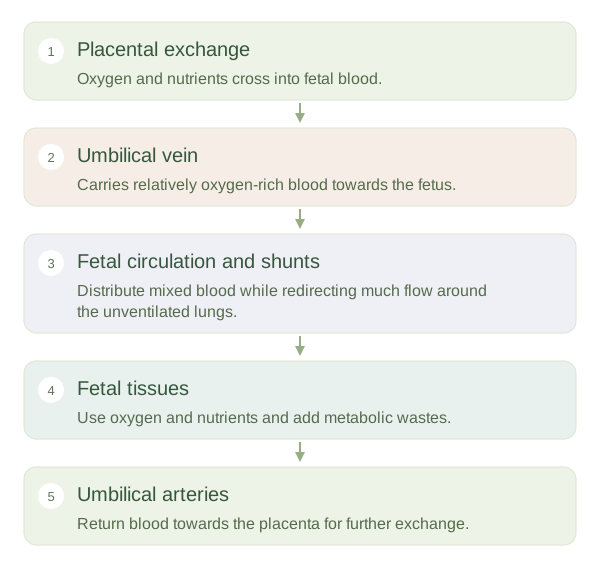
The develops from fetal tissues interacting with the maternal endometrium. Branching chorionic villi contain fetal capillaries, while maternal blood flows through spaces around them. Oxygen and nutrients move towards fetal blood, and carbon dioxide and other wastes move towards maternal blood. The circulations normally remain separated by an exchange barrier rather than flowing together through one shared vessel. Some cells and substances can cross, so the barrier is selective rather than absolute.
Placental supply and fetal shortcuts
 Open diagram larger ↗
The cord has unusual directions
The carries relatively oxygen-rich blood from the towards the fetus. Two umbilical arteries carry blood back towards the placenta. This can seem reversed until the definitions are recalled: arteries carry blood away from the heart and veins carry it towards the heart. Oxygen content does not define the vessel name. The placenta also produces hormones that support pregnancy and can transfer protective maternal antibodies.
Routing around unventilated lungs
Before birth, the lungs are not providing gas exchange and their vascular resistance is high. Some blood arriving from the passes through the ductus venosus towards the central circulation, bypassing part of the liver. The allows blood to pass from the right atrium to the left atrium. The connects the pulmonary artery to the aorta. These shunts reduce the amount of blood that must pass through the high-resistance fetal lungs.
A transition at birth
With breathing, pulmonary resistance falls and more blood flows through the lungs. Clamping the cord removes placental circulation, changing pressures and contributing to closure of fetal shunts. Functional closure and later anatomical changes do not all occur simultaneously. The fetal system is therefore not a faulty version of adult circulation: it is an arrangement suited to obtaining oxygen from the and then transitioning to lung-based exchange after birth.