Supporting a growing exchange system
Pregnancy places new demands on the body as the uterus and placenta grow. Hormonal signals help coordinate changes in circulation, breathing, metabolism and tissue structure. These adaptations vary between individuals and across pregnancy. Their purpose is not simply to make more space: the body must deliver oxygen and nutrients, handle additional waste and maintain suitable conditions for both maternal tissues and fetal development.
Whole-body adaptation in pregnancy
 Open diagram larger ↗
More circulating volume
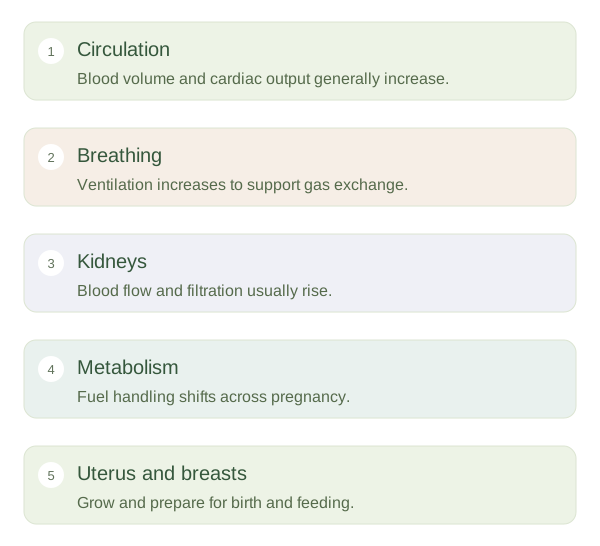
Blood volume increases, and the heart generally pumps more blood each minute. Plasma often increases proportionally more than red-cell mass, so haemoglobin concentration can fall through dilution even though red-cell production has increased. This physiological dilution is not the same as proving that all anaemia is normal. Changes in vessel tone and the growing uterus also alter circulation. In later pregnancy, the uterus can compress large veins in some positions and affect venous return.
Breathing, kidneys and fuel
Progesterone contributes to increased ventilation, helping remove carbon dioxide and supporting placental gas exchange. The diaphragm changes position as the uterus enlarges, but breathing adaptations are not explained by pressure alone. Kidney blood flow and filtration generally increase, changing the handling of water and dissolved substances. Metabolism also shifts: later pregnancy commonly involves reduced , helping make nutrients available to the fetus. This is regulated adaptation, although excessive disturbance can produce clinical problems such as gestational diabetes.
Preparing tissues for birth and feeding
The uterus grows through changes in its muscle cells and supporting blood supply. Breast tissue develops under hormonal influence in preparation for milk production. Connective tissues and the pelvic region also change, contributing to altered posture and joint mechanics. Common discomforts can follow these structural changes, but an expected physiological mechanism does not make every symptom harmless. The central lesson is that pregnancy involves whole-body coordination, with overlapping normal variation and conditions requiring individual clinical assessment.