A coordinated onset
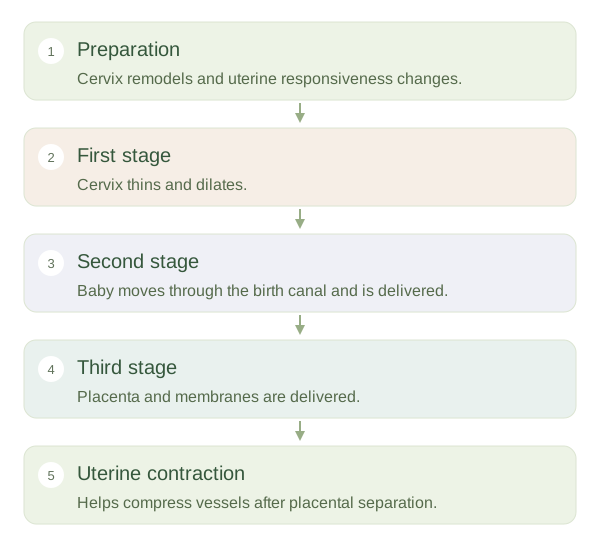
Labour is the process that leads to birth through coordinated uterine contractions and changes in the cervix. Its onset involves interacting fetal, placental and maternal signals rather than one simple switch. Near term, the uterus becomes more responsive to contraction-promoting signals, and the cervix softens and remodels. Irregular preparatory contractions can occur before labour; contractions alone do not prove that progressive cervical change is occurring.
The stages of birth
 Open diagram larger ↗
The first and second stages
During the first stage, contractions are associated with cervical , meaning thinning, and , meaning opening. The cervix gradually becomes sufficiently open for birth. In the second stage, from full dilation to delivery of the baby, uterine contractions and maternal pushing can move the baby through the birth canal. The baby usually undergoes positional adjustments as it passes through the pelvis. Timing and progression vary; a simple diagram cannot predict an individual birth.
Feedback and muscle work
Oxytocin and locally produced prostaglandins help support contractions. Cervical stretch can increase neural signalling to the brain and promote further oxytocin release, creating positive feedback. Stronger contractions can produce additional stretch until birth changes the stimulus. Uterine smooth muscle supplies involuntary force, while abdominal and pelvic muscles contribute during pushing. This cooperation differs from moving an arm: birth involves a muscular organ, changing connective tissue and a constrained anatomical passage.
The third stage and transition
The third stage involves separation and delivery of the placenta and associated membranes. Continued uterine contraction compresses vessels at the placental attachment site and helps limit bleeding. Birth also requires rapid newborn adjustments, including breathing and changes in circulation. Vaginal birth is not the only route: caesarean birth delivers through surgical openings in the abdominal and uterine walls when chosen or clinically indicated. Understanding the stages explains anatomy and physiology without prescribing how any individual birth should be managed.