Changing ovarian activity
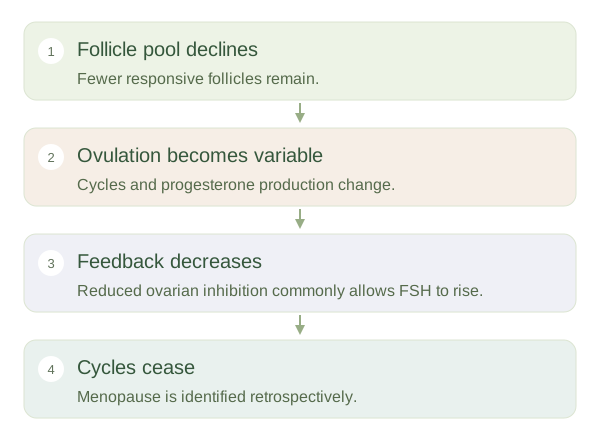
The number of ovarian follicles declines across life. As the remaining follicle pool becomes smaller and less responsive, ovulation and hormone production become less predictable. is the transition during which cycles often change and symptoms may appear. is recognised retrospectively after twelve consecutive months without menstruation when there is no other explanatory cause. It marks the end of spontaneous menstrual cycles, rather than the disappearance of every hormone from the body.
Ovarian ageing and feedback
 Open diagram larger ↗
A changing feedback pattern
Ovarian oestrogen and normally restrain pituitary gonadotropin release. With reduced follicular activity, this restraint decreases, so FSH commonly rises. Progesterone production also changes because ovulation and corpus luteum formation become less consistent. Fluctuating and later lower oestrogen can affect temperature regulation, contributing to hot flushes, and can alter vaginal and urinary tissues. Lower oestrogen also influences bone remodelling, helping explain changes in bone loss risk. Symptoms and their intensity vary widely.
Other reproductive ageing patterns
Testicular function usually changes more gradually. Testosterone levels may decline with age, but there is no universal abrupt event equivalent to . Sperm production can continue, although fertility and sperm characteristics may change. Health conditions and medication effects can overlap with age-related changes in hormone levels or sexual function. It is therefore misleading to assume that any symptom in later life is caused by one hormone or that every older person follows the same pattern.
Ageing beyond fertility
The end of menstrual cycles does not determine identity, wellbeing or capacity for intimacy. may also occur earlier through removal of ovaries or some medical treatments, which differs from the usual gradual transition. Understanding feedback helps explain the biology without turning age-related change into a single diagnosis. Individual assessment considers symptoms, medical history and other possible causes; this lesson explains mechanisms rather than recommending hormone treatment or predicting an individual's reproductive lifespan.