Fluid between cells
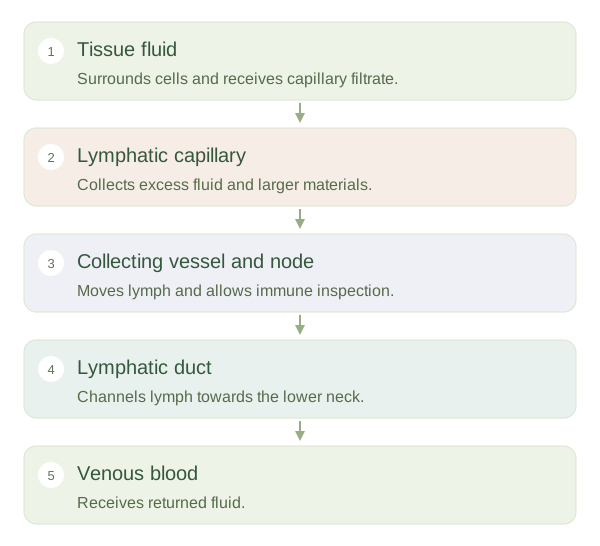
Blood capillaries exchange water and dissolved substances with the fluid surrounding body cells. Some filtered fluid remains in the tissues rather than returning directly across blood-capillary walls. Blind-ended lymphatic capillaries collect this fluid, which is then called . Their overlapping lining cells allow tissue fluid and larger materials to enter when local pressure rises. This drainage helps prevent fluid accumulation and provides a route for immune surveillance.
From tissue spaces back to veins
 Open diagram larger ↗
Moving without a central pump
Lymphatic capillaries join larger collecting vessels containing valves. The valves favour movement towards the central circulation and limit backward flow. Contraction of the vessel walls, nearby skeletal-muscle activity and pressure changes during breathing all help propel . There is no separate lymphatic heart pumping the whole network. Reduced movement or obstruction can therefore affect drainage, although the causes of swelling are varied and cannot be identified from appearance alone.
Where the network leads
passes through lymph nodes, where immune cells can inspect material arriving from tissues. Larger vessels form trunks and ducts. The drains most of the body, while the right lymphatic duct drains a smaller region including much of the right upper body. These routes empty near the junctions of major veins in the lower neck. The lymphatic system is a return pathway, not a second circuit carrying blood out from the heart.
A route for dietary fat too
Special lymphatic capillaries in intestinal villi are called lacteals. They absorb many dietary fats packaged into particles called chylomicrons. These particles are too large to enter ordinary intestinal blood capillaries directly in the same way as many sugars and amino acids. Fat-containing intestinal eventually joins the bloodstream through the lymphatic ducts. Fluid balance, nutrient transport and immune defence are therefore linked through one network, rather than being three unrelated jobs.