An organised local response
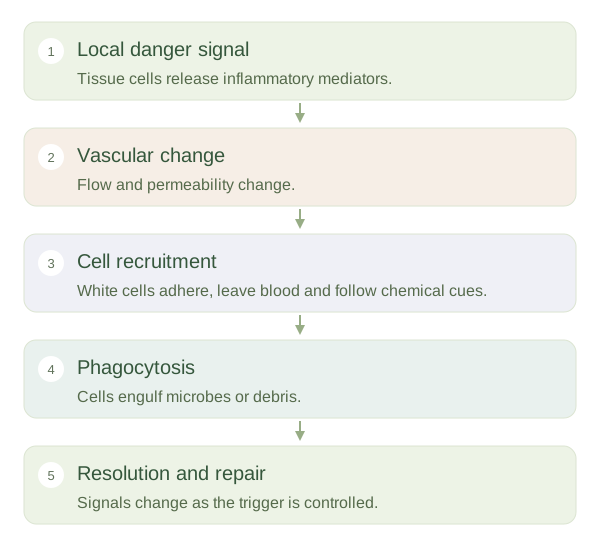
is a response to tissue injury, infection or other disturbances. Local cells detect danger and release signals that change blood vessels and recruit immune cells. Increased blood flow can produce warmth and redness, although redness is less easy to recognise in some skin tones. Increased vascular permeability allows proteins and fluid to enter tissues, contributing to swelling. Pain can arise from chemical signals and pressure on sensitive structures.
From injury signal to clearance
 Open diagram larger ↗
Recruiting the right cells
Endothelial cells lining nearby vessels change their surface molecules in response to inflammatory signals. Circulating white cells can slow, adhere and then pass between or through endothelial cells into the tissue. Chemical gradients guide them towards the affected site. Neutrophils are often prominent early in acute , while monocytes can enter and develop into macrophages. The exact pattern depends on the cause and tissue; not every inflammatory response contains the same cells.
Engulfing and clearing
Phagocytes bind material, surround it with membrane and enclose it in an internal compartment. Fusion with enzyme-containing compartments helps break down microbes and debris. Coating a target with antibodies or complement can make recognition easier; this is called . Macrophages also help clear dead cells and release signals that influence repair. Phagocytosis is therefore part of both defence and cleanup, rather than simply a battle against bacteria.
Stopping matters too
A successful response must eventually resolve: the trigger is controlled, recruited cells are removed or change activity, and tissue repair proceeds. Persistent can contribute to fibrosis and organ dysfunction. Inflammation is not synonymous with infection; a sprained ankle can inflame without microbial invasion. Conversely, an infection may produce different degrees of visible inflammation. Understanding this distinction prevents the mistaken conclusion that every swollen or painful tissue contains a pathogen or requires the same treatment.