Specific recognition
B cells and T cells are lymphocytes central to adaptive immunity. Each cell has receptors with particular recognition properties, and the body maintains many different receptor types. When an appropriate is encountered together with the required activation signals, matching cells can multiply. This clonal expansion increases the number of cells suited to the current threat. Activation is regulated because recognising a molecular feature alone should not always trigger an unrestricted response.
Two adaptive toolkits
 Open diagram larger ↗
B cells and antibodies
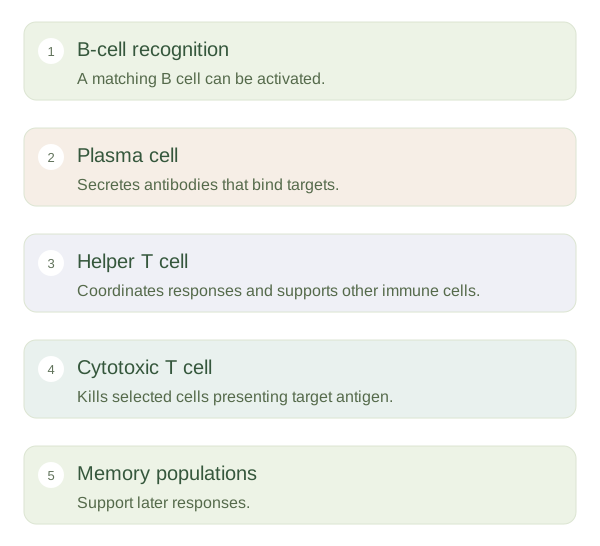
Activated B cells can develop into plasma cells that release antibodies. Antibodies bind specific molecular features called epitopes. Binding can block a toxin or virus from attaching to a cell, coat a microbe for phagocytosis, or activate complement. Antibodies do not usually destroy every target directly on their own; they often mark or neutralise it and recruit other mechanisms. Some activated B cells become memory cells that support faster responses to later encounters.
T cells and presented information
T-cell receptors recognise fragments presented by major histocompatibility complex, or MHC, molecules on cell surfaces. Helper T cells coordinate other cells through contact signals and cytokines, including support for many B-cell responses. Cytotoxic T cells can kill infected or abnormal body cells displaying appropriate target signals. This differs from an binding a free particle: T cells inspect information presented by other cells. Regulatory T cells also help restrain harmful responses.
Working together
Antigen-presenting cells help start T-cell responses, and helper T cells can improve B-cell activation and quality. Adaptive responses therefore form a network rather than two competing systems. Memory B and T cells can persist after the initial threat is controlled. The useful distinction is between soluble recognition tools, such as antibodies, and cellular functions, such as coordinating responses or destroying infected cells. Effective defence usually depends on both types of activity.