Defence aimed at the wrong target
Hypersensitivity describes immune responses that produce tissue injury or symptoms. Allergy commonly refers to responses against otherwise relatively harmless environmental substances, such as pollen or particular food proteins. The substance acting as the trigger is an . Not every unpleasant reaction to food or medication is an allergy: intolerance and other mechanisms can cause symptoms without the same immune pathway. Accurate terminology matters because mechanisms differ.
A common immediate allergy pathway
 Open diagram larger ↗
An immediate IgE pathway
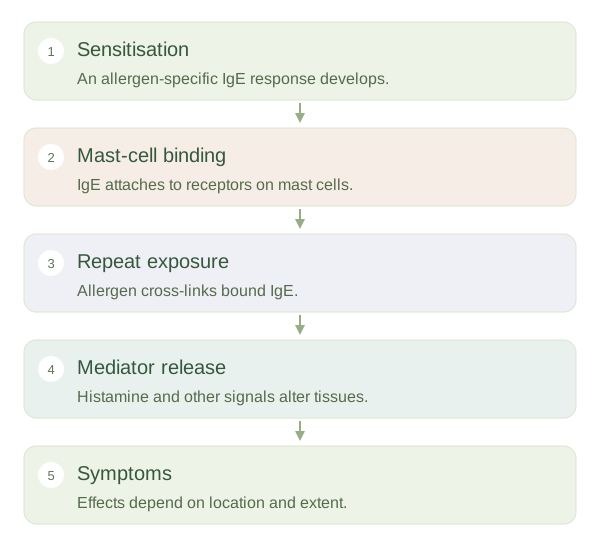
In a common immediate allergic response, an initial sensitisation phase leads B cells to produce antibodies against an . IgE binds receptors on mast cells and related cells. On a later exposure, the allergen can cross-link these surface-bound antibodies, triggering release of mediators including histamine. These mediators change vessels, stimulate sensory nerves and can affect airway smooth muscle and mucus production. The response is inappropriate for the target, not proof that the immune system is simply stronger.
Local and systemic effects
A local reaction may affect the nose, eyes, skin or airways. A severe systemic allergic reaction is called and can compromise breathing and circulation. The same broad mediator system can therefore produce very different consequences depending on where and how extensively it is activated. This lesson explains why effects occur; recognising or managing a suspected acute reaction requires appropriate clinical action rather than attempting a quiz-based diagnosis.
Not all hypersensitivity is immediate
Some hypersensitivity responses involve antibodies other than , immune-complex deposition or T-cell activity. Contact dermatitis from certain substances can involve a delayed T-cell response that develops over a longer period. A rash appearing later is therefore not necessarily caused by the immediate mast-cell mechanism. The useful organising idea is that immune tools normally used for protection can cause harm when their target, location or regulation is unsuitable. One symptom alone does not reveal which pathway is operating.