Keeping the inside stable
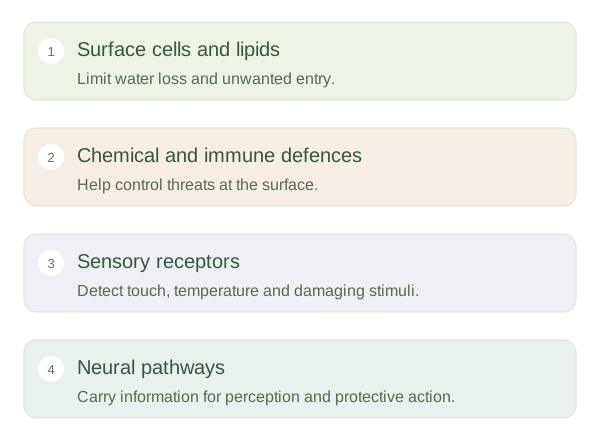
A body made largely of water needs a surface that limits uncontrolled loss. The outer epidermis provides much of this barrier through tightly arranged, keratin-rich cells and lipids between them. A brick-and-mortar analogy is useful: cells resemble bricks and lipids help fill the spaces. The comparison is incomplete because skin is living, renewing tissue rather than a fixed wall. Damage to the barrier can increase water loss and make entry of irritants and microbes easier.
A protective and sensing interface
 Open diagram larger ↗
Several forms of protection
Physical strength, chemical conditions and immune activity work together at the surface. Skin secretions and resident microbes influence which organisms can thrive. Immune cells in and beneath the epidermis can recognise threats and communicate with other defences. Pigment helps protect against some ultraviolet damage, although it does not make any skin completely immune to sun injury. The barrier is selective: some substances penetrate it more readily than others, which is why certain medicines can be delivered through skin while many cannot.
Detecting the world
Sensory nerve endings and specialised receptors detect touch, pressure, vibration, temperature and potentially damaging stimuli. Different receptor types respond to different aspects of stimulation. Some adapt quickly and emphasise change, such as the onset of vibration, while others signal more sustained pressure. Receptor density varies across the body, helping explain why fingertips can distinguish fine detail better than many areas of the back. Signals travel through nerves to the spinal cord and brain, where perception is constructed.
Protection depends on sensation too
Sensation helps protect the barrier by prompting withdrawal from heat, adjustment of pressure or awareness of injury. Loss of sensation can therefore increase injury risk even when the skin initially looks intact. Conversely, an intact-looking surface can still be irritated or painful because sensory and inflammatory signalling have changed. Barrier and sensory functions cooperate, but they are not identical: one controls exchange with the environment, while the other reports information that supports protective behaviour.