Balancing heat gain and loss
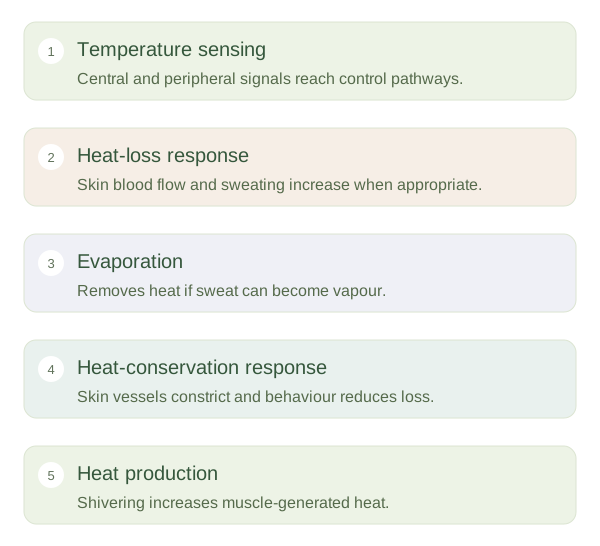
Cells continually produce heat through metabolism. The body also gains or loses heat through its surroundings. Core temperature depends on the balance, not simply on how hot the skin feels. The hypothalamus integrates information from central and peripheral temperature-sensitive pathways and coordinates responses. Skin is a major adjustable interface between the warm internal circulation and the environment, while behaviour—such as seeking shade or adding clothing—also changes heat exchange.
Responding to heat and cold
 Open diagram larger ↗
Changing skin blood flow
When heat needs to be lost, blood vessels supplying the skin can dilate. More warm blood reaches superficial regions, supporting heat transfer to the environment when conditions allow. When conserving heat, constriction reduces skin blood flow and limits transfer from the core. This is why cold skin does not necessarily mean the body has no internal heat. Blood-flow regulation redistributes heat; it does not create cold or guarantee cooling when the surrounding air is hotter than the skin.
Sweating and evaporation
Eccrine glands release watery sweat, and removes heat from the surface. High humidity reduces the air's capacity to accept additional water vapour, making evaporation less effective. Sweat dripping off without evaporating contributes less cooling. Fluid and salt losses also accompany sweating, connecting temperature control with cardiovascular and kidney regulation. Other heat-loss routes include radiation, conduction and convection, with their importance changing according to temperature, airflow and contact surfaces.
Different responses to cold
Shivering generates heat through repeated skeletal-muscle activity. Reduced skin blood flow helps conserve it, while insulation from clothing and subcutaneous fat limits loss. Goosebumps have only a small insulating effect in humans compared with heavily furred animals. Fever involves an altered central temperature target, whereas overheating can result from excess heat gain or inadequate loss without that target change. These mechanisms explain temperature regulation but do not establish the cause or safety of an individual's abnormal temperature.