Collecting a pressure wave
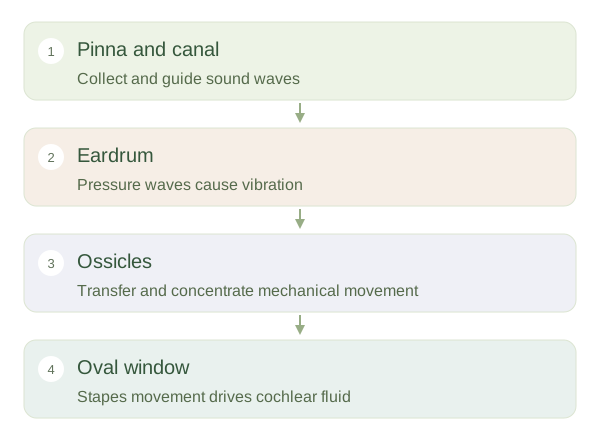
Sound is a travelling variation in pressure. The visible pinna and the external ear canal guide this wave towards the , or eardrum. The canal also protects the delicate membrane using its curved shape, hairs and wax. The eardrum is the boundary between the outer ear and the air-filled middle-ear cavity. When pressure changes reach it, it vibrates. This is mechanical movement; the membrane does not yet create the neural signal that the brain interprets as sound.
Delivering sound to the inner ear
 Open diagram larger ↗
Passing movement into fluid
Three tiny middle-ear bones, the malleus, incus and stapes, link the eardrum to the oval window of the inner ear. Sound must pass from air into cochlear fluid, which resists movement more strongly. The area difference between the large eardrum and small oval window, together with the ossicular lever arrangement, helps concentrate pressure. This improves energy transfer into the inner ear. Small middle-ear muscles can alter movement of this chain, but their reflexes cannot reliably protect hearing from every sudden or prolonged loud sound.
Keeping pressure balanced
The connects the middle ear to the upper throat. It usually stays closed and opens briefly during actions such as swallowing, helping equalise pressure across the eardrum. During a flight, unequal pressure can stretch the membrane and make sounds seem muffled. Fluid in the middle ear can also reduce movement and cause , even when the cochlear sensory cells remain functional. This differs from sensorineural hearing loss, which involves the inner ear or neural pathways. The basic distinction is a problem delivering vibration versus a problem detecting or carrying its message.