Many sensors under one name
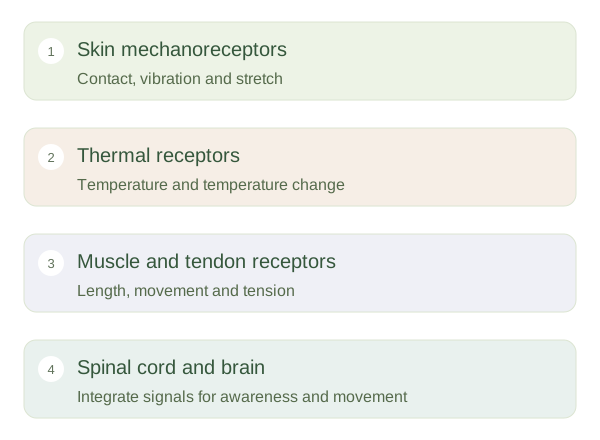
includes information from skin, muscles, tendons and joints. Touch is not one uniform signal: receptors differ in sensitivity to pressure, vibration, stretch and movement across the skin. Some continue responding during a steady stimulus, while others emphasise its beginning or change. A small helps localise contact precisely, explaining why fingertips can distinguish nearby points better than much of the back. The density and wiring of receptors matter, rather than skin thickness alone determining how detailed touch feels.
Body information reaching the nervous system
 Open diagram larger ↗
Temperature and protective information
Temperature-sensitive nerve endings respond across different ranges, and their activity depends partly on change as well as absolute temperature. Very intense heat or cold can also activate nociceptors, receptors involved in detecting potentially damaging conditions. These systems overlap but are not identical: feeling warmth does not automatically mean tissue damage is occurring. Signals travel through peripheral nerves into the spinal cord and onwards through several pathways. The brain combines them with attention and context, so perception is an interpretation of input rather than a direct readout from a single thermometer.
Knowing where your limbs are
is the sense of body position and movement. Muscle spindles report muscle length and changes in length, while Golgi tendon organs provide information related to muscle tension. Joint and skin receptors also contribute. Their signals support both conscious awareness and automatic control through spinal and cerebellar circuits. You can normally touch your nose with your eyes closed because vision is not the only guide to your arm. Stable movement depends on combining position signals with motor commands, allowing rapid correction before every small adjustment needs conscious thought.