Moving the surface
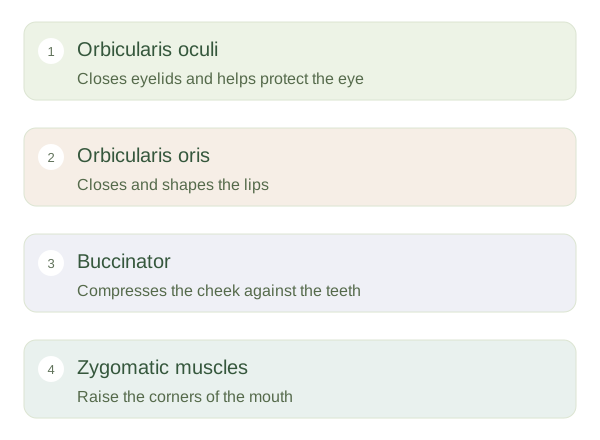
Muscles of facial expression are skeletal muscles, but many attach partly to the skin or other soft tissues. Their contraction therefore changes the shape of the face rather than simply rotating a joint. surrounds the eye and closes the eyelids; contributes to closing and shaping the lips. Zygomatic muscles pull the mouth corners upwards, while other small muscles lift, lower or tighten different facial regions. Expressions usually arise from coordinated patterns of activity, not from one isolated muscle acting like a labelled emotion switch.
Facial muscles and useful actions
 Open diagram larger ↗
Expression also serves function
These muscles do more than communicate feelings. Blinking spreads tears over the cornea and helps protect the eye. Lip closure helps contain food and contributes to speech. The presses the cheek towards the teeth, keeping food between the chewing surfaces. Although it assists eating, it belongs to the facial-expression group and is supplied by the facial nerve. The major jaw-closing muscles, such as masseter, belong to the separate group and receive motor supply from the mandibular division of the trigeminal nerve.
One nerve, many branches
The facial nerve leaves the skull and branches through the face to supply most expression muscles. Damage along its pathway can weaken movements such as closing an eye, raising an eyebrow or smiling, depending on the location. Facial sensation can remain relatively intact because it is mainly carried by the trigeminal nerve. Connections from the brain also differ for voluntary and emotional movements, so examination requires more than watching one smile. For a beginner, the useful organising idea is simple: attachments explain what moves, coordinated activation explains the visible expression, and nerve supply explains which muscles can be controlled together.