Preparing air before it reaches the lungs
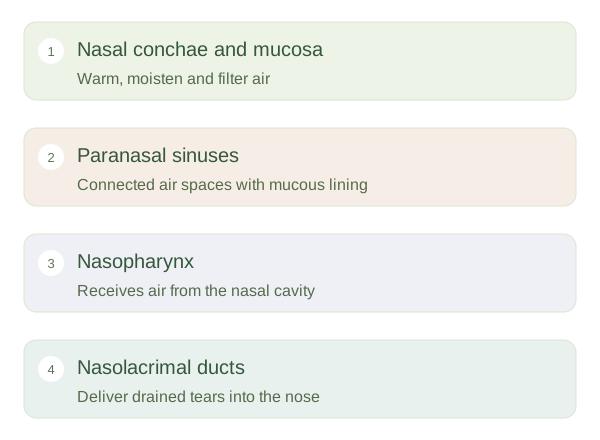
The nasal cavity extends from the nostrils to openings into the nasopharynx. A septum divides the right and left sides. Curved shelves called conchae project from the lateral walls, increasing surface area and influencing airflow. The lining warms and moistens incoming air, while mucus traps particles. Cilia move mucus towards the throat for removal. This is a protective transport system, not simply an empty tube. The olfactory region high in the cavity has a separate sensory role in detecting smell.
Nasal cavity and connected structures
 Open diagram larger ↗
Air spaces within nearby bones
The paranasal sinuses are air-containing spaces within the frontal, ethmoid, sphenoid and maxillary bones. They connect with the nasal cavity through openings and are lined by mucosa continuous with the nasal lining. Their functions include contributing to the lightweight architecture of the face and influencing resonance, although no single proposed function explains every feature. The maxillary sinuses lie beside the nasal cavity and below the orbits; ethmoid air cells lie between the nasal cavity and the orbits. These relationships matter when interpreting a cross-sectional image.
Drainage depends on small openings
Ciliary transport moves sinus mucus towards drainage openings. Swelling of the lining can narrow these routes and interfere with ventilation and drainage. Pressure or discomfort does not identify a cause by itself, but the anatomy explains why a small area of swelling can affect a larger sinus. The nasolacrimal ducts also open into the nasal cavity, accounting for tears reaching the nose. Learning the cavity as a conditioned-air passage with connected side spaces is more useful than assuming every sinus opens directly beside the nostril. The structures are linked, but their exact drainage pathways differ.