Delivering blood to different destinations
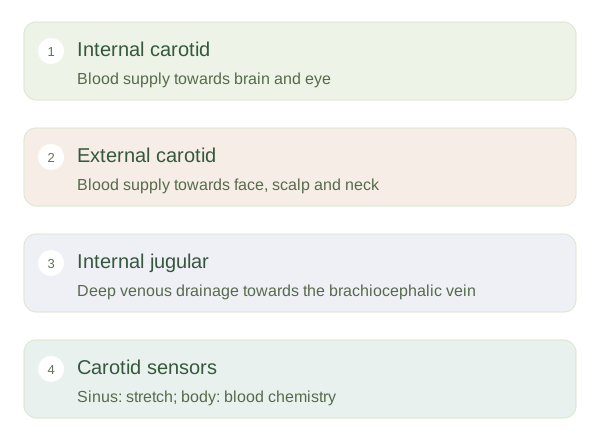
A common carotid artery ascends on each side of the neck. It divides into an , which supplies much of the brain and the eye, and an external carotid artery, which supplies many structures of the face, scalp and neck. The internal carotid normally gives no branches within the neck itself. Blood also reaches the brain through vertebral arteries, which ascend through openings in cervical vertebrae. Cerebral supply therefore depends on more than the carotid system alone.
Neck vessels: supply and return
 Open diagram larger ↗
Returning blood towards the heart
The is a major drainage route from the brain and deep head and neck. It runs alongside the carotid artery within the carotid sheath, with the vagus nerve positioned between them towards the back. The internal jugular joins the subclavian vein to form the brachiocephalic vein. More superficial drainage includes the external jugular vein, which crosses the sternocleidomastoid region. Veins are usually more compressible than arteries and their fullness varies with pressure, posture and breathing. Visible neck veins therefore reflect venous conditions rather than being surface arteries.
Sensing pressure, not just carrying blood
Near the carotid bifurcation, the contains stretch-sensitive receptors that help monitor blood pressure. The nearby responds mainly to chemical changes in arterial blood, including reduced oxygen. These signals participate in automatic cardiovascular and respiratory regulation. The two structures have related locations but different sensory jobs. Their presence illustrates a wider principle: blood vessels can be both transport pathways and sites of physiological monitoring. For regional learning, identify destination, return route and neighbouring nerve before memorising individual smaller branches. This makes the neck’s vascular arrangement easier to relate to the rest of the circulation.