One passage with several regions
The is a muscular passage behind the nose, mouth and larynx. Its upper part, the nasopharynx, normally carries air from the nasal cavity. The oropharynx lies behind the mouth, and the laryngopharynx lies behind the larynx. The lower two regions participate in both breathing and swallowing. Inferiorly, the food route continues into the oesophagus, while air enters the larynx in front. These shared relationships make coordinated routing essential: swallowing is not simply dropping food down a permanently separate pipe.
Protecting the airway during a swallow
 Open diagram larger ↗
A brief change in priorities
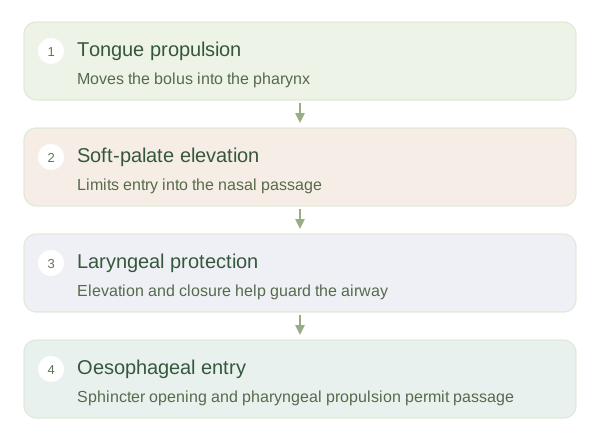
A swallow begins with the tongue moving a prepared towards the throat. The soft palate elevates to limit entry into the nasopharynx. The hyoid and larynx move upwards and forwards, the vocal folds close, and the epiglottis contributes to covering the laryngeal entrance. Pharyngeal muscles propel the bolus towards the opening . Breathing pauses briefly while this sequence occurs. Airway protection uses several coordinated mechanisms; it does not depend on the epiglottis acting as a single perfect hinged lid.
Why timing and sensation matter
Sensory information helps trigger and adjust the swallowing sequence through brainstem and higher neural networks. Food entering the airway is , which differs from food entering the oesophagus normally. Cough can help clear material, but not every aspiration event produces an obvious cough. Structural problems, muscle weakness or impaired neural coordination may disrupt different stages of swallowing. The anatomy also explains why the throat can serve voice, breathing and eating without those functions occurring identically at the same moment. Understanding the shared passage and its moving protective structures is more useful than picturing the throat as a rigid funnel.