A gland around the airway
The thyroid lies in the lower anterior neck, with right and left lobes joined by an isthmus across the front of the upper trachea. It sits below the larynx and is related to the airway rather than being part of the air passage. lie in front, while carotid sheaths lie towards the sides. The gland moves with swallowing because of its fascial attachments to nearby structures. This relationship helps distinguish its regional position from a gland floating independently beneath the skin.
Neighbours of the thyroid region
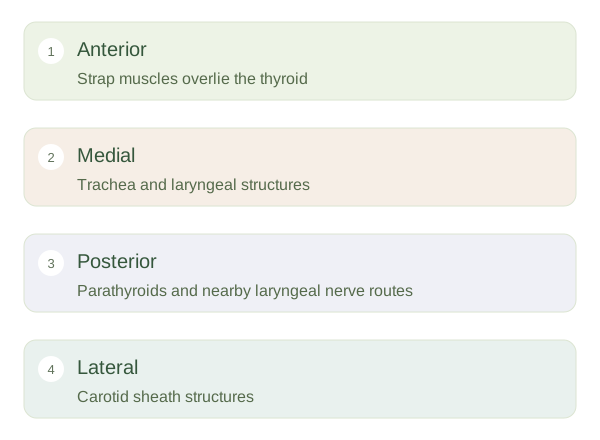 Open diagram larger ↗
Small neighbours with a different role
Parathyroid glands are small endocrine structures usually found on the posterior aspect of the thyroid. Four is common, but their number and precise locations vary. They release parathyroid hormone, which helps regulate calcium balance. Thyroid tissue produces thyroid hormones and also contains calcitonin-producing cells, so similarly located glands do not have interchangeable functions. Their close relationship is anatomical rather than proof that they are one organ. Small blood vessels supplying the region are important because functioning endocrine tissue needs a dependable blood supply despite its modest size.
Nerves beside the glands
Recurrent laryngeal nerves travel near the back of the thyroid region, often close to the groove between trachea and oesophagus, before entering the larynx. Their motor branches are important for vocal-fold movement. The external branch of the superior laryngeal nerve lies near the superior thyroid vessels and contributes to pitch control through cricothyroid. These relationships explain why changes affecting the thyroid region can have consequences beyond hormone levels. Enlarged tissue can also relate closely to the trachea or oesophagus. Regional anatomy is therefore about neighbours and routes as well as identifying the gland itself.