A column with several jobs
The vertebral column supports the head and trunk, transfers weight towards the pelvis, and protects the spinal cord. It is built from a series of vertebrae rather than one rigid rod. Each typical has a solid body towards the front and a bony arch behind. Together these surround a , an opening. The aligned openings form the spinal canal. Projections called processes give muscles and ligaments attachment points and form joints with neighbouring vertebrae. The canal and the weight-bearing body therefore perform different but connected tasks.
Vertebrae and Spinal Regions — concept map
 Open diagram larger ↗
Regional differences
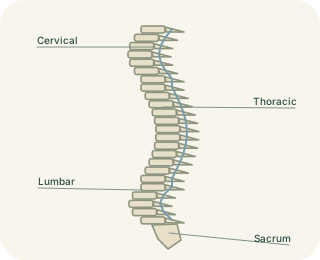
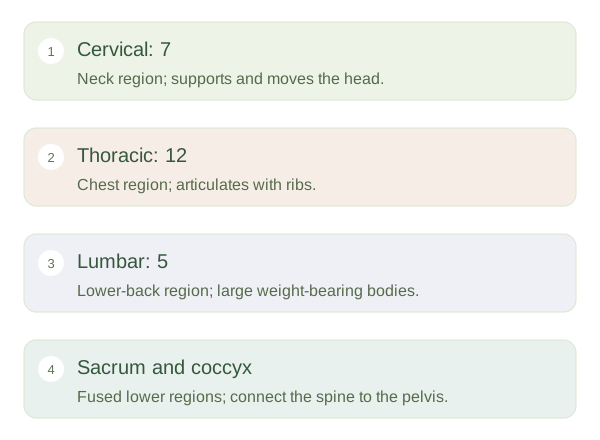
There are usually seven cervical vertebrae in the neck, twelve thoracic vertebrae in the chest, and five lumbar vertebrae in the lower back. Below these, fused vertebrae form the sacrum and usually the coccyx. Cervical vertebrae permit substantial head movement. The first two, the atlas and axis, are specially shaped for nodding and turning. Thoracic vertebrae connect with ribs, helping build a protective chest. Lumbar bodies are larger because they support more weight. These differences reflect each region’s mechanical responsibilities, rather than being arbitrary changes in appearance.
Support without complete rigidity
Between most adjacent vertebral bodies are discs, while small facet joints connect the arches. Small movements at many levels add up to a flexible back. The sacrum links this moving column to the pelvic ring, distributing forces into the lower limbs. Nerves leave through openings between neighbouring vertebrae, not through the solid vertebral bodies. This explains why narrowing around an exit can disturb a nerve without breaking the spine. When describing a spinal level, names such as L4 refer to a particular or region; the nearby spinal cord segment is not always at the same height.