A resilient spacer
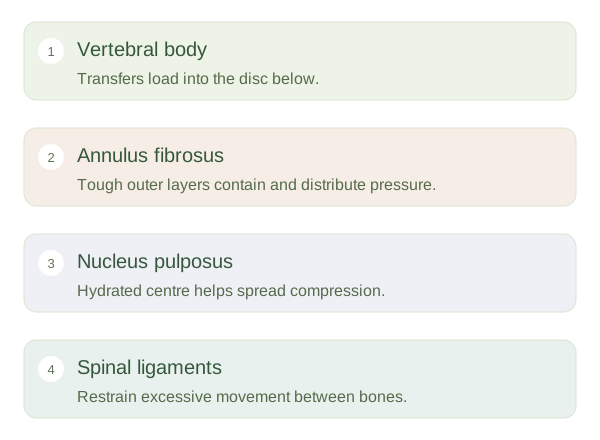
An intervertebral disc sits between most neighbouring vertebral bodies, from C2–C3 down to L5–S1. Each disc has a tough outer surrounding a more hydrated centre, the . Imagine a reinforced cushion rather than a loose ball. Pressure in the centre distributes force into the outer layers and adjoining vertebral endplates. Discs help maintain space for nerve exits and allow small tilting movements. They are not found between the skull and atlas or between atlas and axis, where specialised joints permit head movement.
Intervertebral Discs and Spinal Ligaments — concept map
 Open diagram larger ↗
Ligaments provide restraint
Ligaments are strong bands of connective tissue joining bones. The anterior longitudinal runs along the front of the vertebral bodies and helps resist excessive extension. The posterior longitudinal ligament lies behind the bodies, inside the canal, and contributes to restraint during flexion. Ligamenta flava connect neighbouring arches and contain elastic fibres. Other ligaments connect the spinous processes and support the back of the column. None works alone: the discs, facet joints and ligaments form a linked system that guides movement and prevents uncontrolled separation.
A changing mechanical system
Discs have limited direct blood supply. Their living cells depend largely on substances moving through surrounding tissues and endplates. Disc hydration changes with loading, and discs commonly become less hydrated with ageing. These changes do not automatically mean pain or disability. Muscles add active control to the passive restraint supplied by ligaments. When you bend, disc pressure, tension and muscle activity all change together. This is why spinal stability cannot be understood simply as having strong bones. It depends on the condition and coordination of several tissues, each contributing a different kind of support.