From the stomach to mobile loops
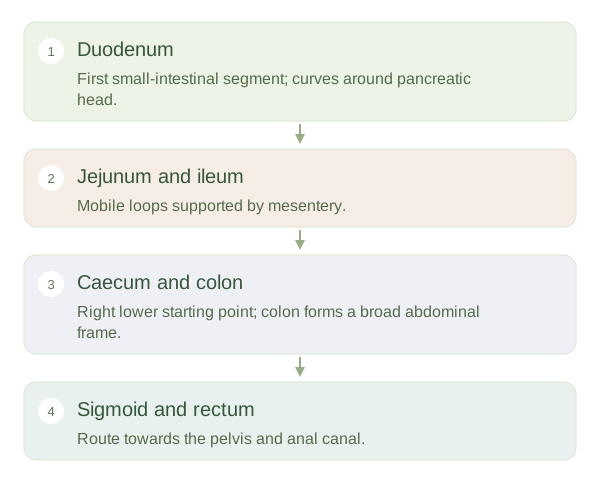
The small intestine begins at the duodenum, which curves around the pancreatic head. Much of the adult duodenum is relatively fixed behind the peritoneum. The and continue as long mobile loops suspended by mesentery. Jejunal loops are often more prominent towards the upper left abdomen and ileal loops towards the lower right, although the arrangement varies. Their mesentery carries the blood vessels, lymphatics and nerves required for absorption. The loops can move without twisting every vessel independently because their connections are organised through this shared supporting fold.
Small and Large Bowel Arrangement — concept map
 Open diagram larger ↗
A larger outer route
The joins the in the right lower abdomen at the ileocaecal junction. The appendix arises from the caecum, but its tip can point in several directions. The colon then ascends on the right, turns below the liver, crosses the abdomen as the transverse colon, and descends on the left. The sigmoid colon curves towards the pelvis before continuing into the rectum. This creates a broad frame around many small-bowel loops. The rectum is not simply another mobile abdominal loop; it is a more fixed pelvic segment leading towards the anal canal.
Attachments shape movement
The transverse and sigmoid colons have mesenteries and can be relatively mobile. Ascending and descending colon are commonly attached more closely to the posterior abdominal wall. These attachment patterns help explain why bowel segments do not all move alike. They also influence how a loop may twist or where fluid can track around it. The small intestine’s main task is digestion and absorption, while the colon reclaims water and electrolytes and helps form stool. The names and positions provide a route map, but their value lies in connecting that route with the different functions of each segment.