Arterial routes into the pelvis
The abdominal aorta divides into common iliac arteries, each of which divides into internal and external iliac branches. The supplies much of the pelvic walls, organs and perineum through several branches. The external iliac artery continues towards the lower limb and becomes the femoral artery beyond the inguinal ligament. There are important exceptions to a simple pelvic supply rule: ovarian and testicular arteries arise higher from the abdominal aorta. Arterial patterns vary, and neighbouring branches can form connections. A regional map therefore needs both general routes and awareness of exceptions.
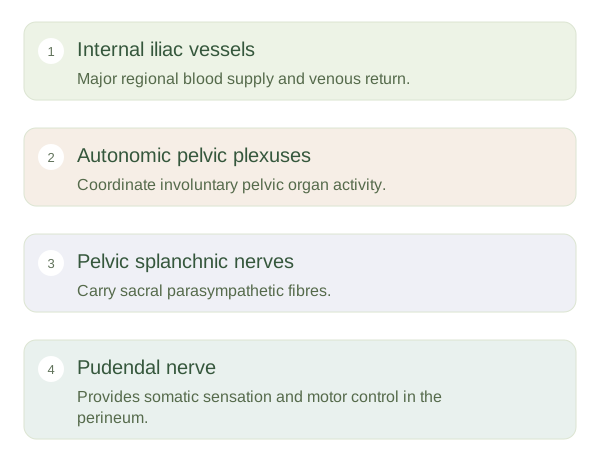
Pelvic Vessels and Nerves — concept map
 Open diagram larger ↗
Venous return and lymph
Pelvic veins commonly form networks, or plexuses, around organs such as the bladder, prostate and rectum. Much blood returns through internal iliac veins into common iliac veins and then the inferior vena cava. The rectal region has connections between systemic veins and the portal circulation, so its drainage is not described accurately by one vessel alone. Lymphatic vessels carry tissue fluid through pelvic and other regional nodes before returning it to the blood. Drainage follows the particular organ and its development; external genital skin and internal pelvic organs do not necessarily share the same first lymph-node group.
Different kinds of nerve control
Autonomic nerves regulate involuntary organ activity. Parasympathetic fibres from sacral levels S2–S4 travel in and contribute to bladder emptying and other functions. Sympathetic fibres reach pelvic plexuses through other routes, helping coordinate storage and reproductive responses. Somatic nerves serve voluntary muscles and skin sensation. The , also associated with S2–S4, supplies important external sphincters and much of the perineum; it is not simply another name for the parasympathetic pathway. Sharing spinal levels does not make nerves functionally identical. Pelvic control combines these systems with signals from the brain and sensory information from the organs.