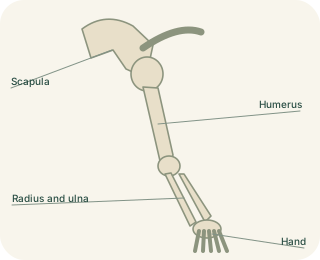
The girdle positions the arm
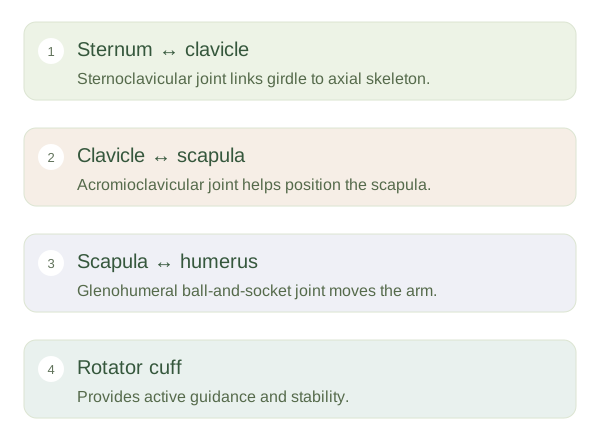
The shoulder, or pectoral, girdle consists of the clavicle and scapula. The clavicle joins the sternum at the sternoclavicular joint and the scapula at the acromioclavicular joint. The sternoclavicular joint provides the upper limb’s main bony connection to the axial skeleton. The scapula rests against the back of the rib cage, supported and moved by muscles rather than a conventional joint between scapula and ribs. Moving the girdle positions the socket so that the arm can reach in many directions. Shrugging, reaching forwards and pulling the shoulders back all involve girdle movement.
Shoulder Girdle and Glenohumeral Joint — concept map
 Open diagram larger ↗
A shallow socket allows freedom
The glenohumeral joint connects the head of the humerus with the of the scapula. It is a ball-and-socket joint, allowing flexion, extension, abduction, adduction and rotation. The glenoid is relatively shallow compared with the large humeral head. A fibrocartilaginous rim, the , increases its depth, but the joint remains much less enclosed by bone than the hip. Its capsule is relatively loose, allowing a large range. This arrangement favours reaching and handling objects, while creating a greater need for soft-tissue and muscular stability.
Mobility needs active support
Rotator cuff muscles compress and guide the humeral head against the glenoid during movement. Other muscles move the arm and scapula, while ligaments and the capsule help limit excessive displacement. Stability is therefore both passive and active. An injury at the acromioclavicular joint is different from a glenohumeral dislocation, even though both are often described informally as a shoulder injury. Understanding which bones meet at each joint avoids this confusion. When the hand rises above the head, motion occurs at several shoulder-complex joints rather than at the glenohumeral joint alone.