Four muscles around one joint
The is formed by the tendons of supraspinatus, infraspinatus, teres minor and subscapularis. These muscles start on the scapula and attach near the top of the humerus. Their tendons blend with the shoulder joint capsule around its superior, posterior and anterior aspects. Supraspinatus runs above the joint, infraspinatus and teres minor lie behind it, and subscapularis crosses the front. The word cuff describes their arrangement around the humeral head, not a separate sleeve of muscle floating inside the joint. Their attachments create useful directions of pull.
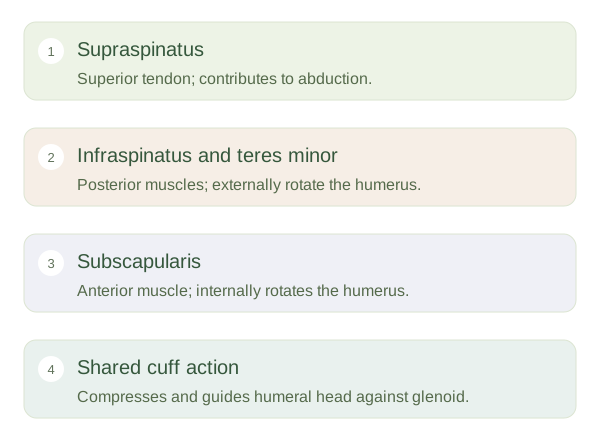
Rotator Cuff — concept map
 Open diagram larger ↗
Different actions, shared control
Supraspinatus contributes to arm , helping move the arm away from the body. Infraspinatus and teres minor externally rotate the humerus. Subscapularis internally rotates it. These actions overlap with other muscles and vary with arm position. Together, the cuff also compresses the humeral head towards the glenoid and helps control its movement while larger muscles, such as the deltoid, lift the arm. Without this guidance, a powerful upward pull would not automatically keep the ball centred in its shallow socket. Stability here is an ongoing muscular task.
Tendons in a crowded region
The supraspinatus tendon passes beneath the acromion on its way to the humerus. A nearby helps reduce friction between tissues. Tendons can develop age-related changes, become painful or tear; a tear may alter strength and control, but imaging changes do not always match symptoms. pain is not identical to a shoulder dislocation, and the cuff is not the same structure as the labrum. Understanding these distinctions helps interpret the language used in shoulder discussions. The essential concept is cooperation: four muscles with different pulling directions can together maintain a controlled, mobile joint.