Arm means shoulder to elbow
In anatomical language, the arm is the region between shoulder and elbow; the forearm lies between elbow and wrist. The humerus is the arm’s long bone. Strong connective tissue divides the surrounding muscles into anterior and posterior compartments. These compartments provide an organising map, although individual muscles can act at more than one joint. Muscles move bones by pulling through tendons; they cannot actively push a bone away. Opposing groups therefore work together to produce and control movement. A compartment name describes a location, not a completely isolated space with no communicating vessels.
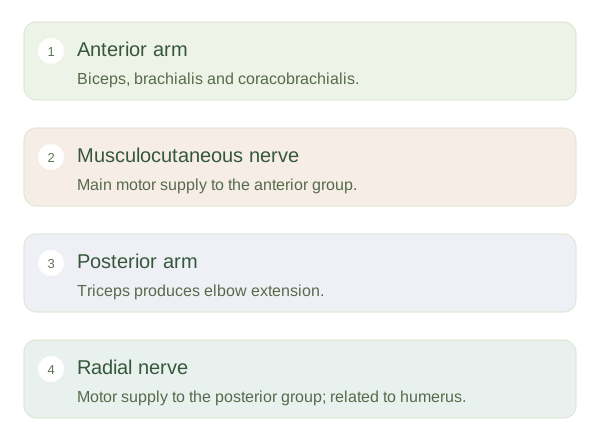
Arm Compartments and Main Muscles — concept map
 Open diagram larger ↗
The anterior group
Biceps brachii has two proximal heads and crosses both shoulder and elbow. It contributes to elbow flexion and is a powerful forearm supinator, especially with the elbow bent. lies deeper and is an important elbow flexor across different forearm positions. Coracobrachialis mainly acts at the shoulder, helping flex and adduct the arm. The musculocutaneous nerve supplies most of this compartment’s motor function. Biceps does not simply flex the elbow in every task; its tendon attachment to the radius explains why it can also rotate the forearm.
The posterior group
has three heads and is the major elbow extensor. Its long head also crosses the shoulder and contributes to shoulder movements. The radial nerve supplies triceps and travels close to the humerus along part of its route. This proximity helps explain why certain humeral fractures can affect radial nerve function. Elbow movement requires coordinated flexor and extensor activity: one group may generate movement while the other controls its speed or steadies the joint. The compartment model links structure, action and nerve supply, but clinical examination still tests several muscles because injury patterns depend on the precise level of a nerve lesion.