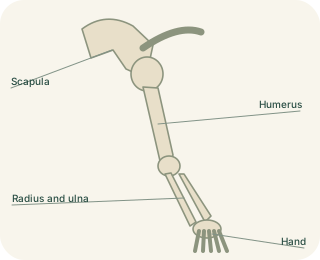
A hinge for bending
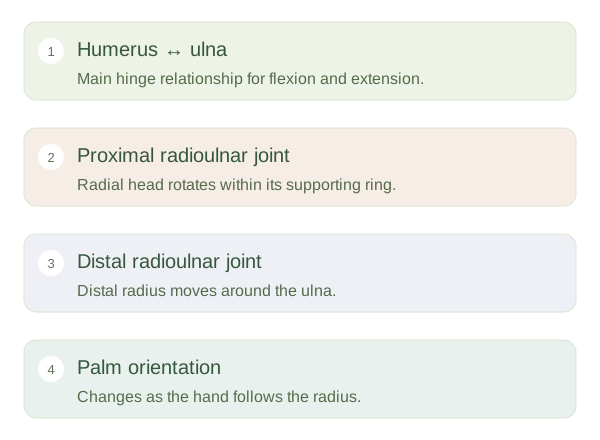
The elbow region contains articulations between the humerus, ulna and radius. The humeroulnar articulation acts chiefly as a hinge, allowing flexion and extension. The ulna’s trochlear notch fits around the humeral trochlea, providing substantial bony guidance. Collateral ligaments help resist sideways forces. The humeroradial articulation also participates as the elbow moves. Bending the elbow brings the hand closer to the shoulder, but it does not by itself determine whether the palm faces upwards or downwards. That orientation depends largely on rotation within the forearm.
Elbow and Forearm Rotation — concept map
 Open diagram larger ↗
A pivot system for turning
The radius lies on the thumb side in anatomical position, while the ulna lies on the little-finger side. During , the bones are approximately parallel and the palm faces forwards in anatomical position or upwards when the elbow is flexed. During , the radius crosses over the ulna as the hand turns. Movement occurs at both proximal and distal radioulnar joints. The holds the radial head against the ulna while allowing it to rotate. The hand follows the distal radius, explaining how forearm rotation changes palm direction without requiring rotation at the wrist itself.
Muscles choose the movement
Brachialis and biceps contribute to elbow flexion, while triceps extends it. Supinator and biceps help supinate the forearm; pronator teres and pronator quadratus help pronate it. A person turning a key may combine these movements with shoulder positioning and wrist control. The distinction matters when interpreting a limitation: difficulty straightening the elbow and difficulty turning the palm describe different mechanical problems. Both can arise near the same region but involve different joint relationships. Anatomy gives a precise movement vocabulary so that function can be described before discussing any possible cause of dysfunction.