Muscles above, movement below
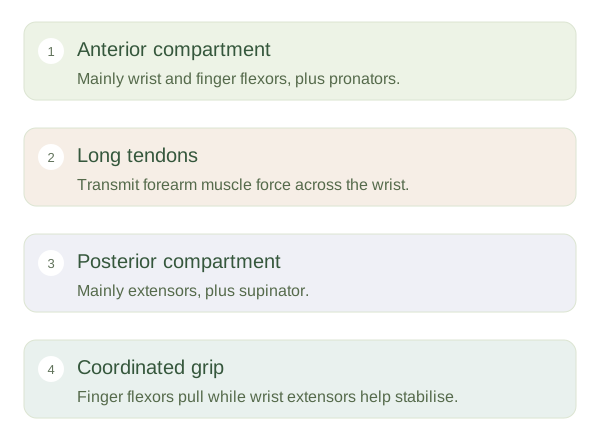
The forearm contains the radius and ulna, surrounded by muscles organised broadly into anterior and posterior compartments. Many muscles begin near the elbow or along these bones and send long tendons across the wrist. Their muscle bellies can therefore generate force without filling the hand with bulky tissue. The anterior group mainly flexes the wrist or fingers and includes forearm pronators. The posterior group mainly extends the wrist or fingers and includes a supinator. These are useful patterns, but some muscles have actions or positions that do not fit a simple front-versus-back rule.
Forearm Flexors and Extensors — concept map
 Open diagram larger ↗
Flexors and extensors cooperate
Flexor digitorum superficialis mainly bends the middle finger joints, while reaches the distal phalanges and bends the fingertip joints. Flexor pollicis longus acts on the thumb. Wrist flexors position the wrist and can deviate it towards one side or the other. Posterior tendons extend the wrist and digits. When gripping an object, wrist extensors often hold the wrist steady while finger flexors pull. This prevents the wrist simply collapsing into flexion as the fingers tighten. Movement depends on coordinated stabilisation as well as the action of the visibly moving part.
Nerves organise the groups
The median nerve supplies most anterior forearm muscles, with important ulnar-nerve exceptions including flexor carpi ulnaris and the medial part of . The radial nerve and its deep continuation supply posterior muscles. This arrangement helps connect a nerve injury with a pattern of weakness rather than one isolated movement. Tendons pass through supporting connective-tissue structures near the wrist, where friction is reduced by specialised coverings. The long route from muscle to finger explains why a cut tendon can impair hand movement even when the muscle itself is uninjured. Muscle, tendon, joint and nerve are separate links in the same functional chain.