A flexible wrist with a firm passage
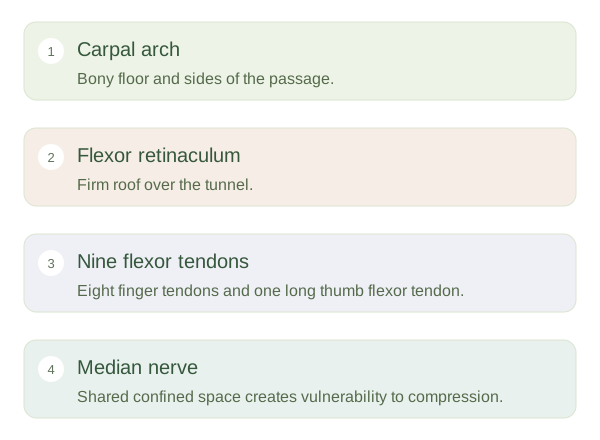
Eight carpal bones form the bony wrist region. Their palmar surface creates an arch, bridged by a strong band called the . Together they form the . This is a real anatomical passage rather than the entire wrist. It contains the and nine finger-flexor tendons: four from flexor digitorum superficialis, four from flexor digitorum profundus and one from flexor pollicis longus. Other structures follow different routes. In particular, the ulnar nerve travels through a separate superficial passage near the wrist rather than through the carpal tunnel.
Wrist and Carpal Tunnel — concept map
 Open diagram larger ↗
Crowding can affect a nerve
The tunnel’s firm boundaries limit how much it can expand. Swelling or other changes within the passage can increase pressure on the . syndrome refers to symptoms and signs associated with this nerve being affected at the wrist. The median nerve supplies sensation to much of the palmar thumb, index and middle fingers and the thumb-side half of the ring finger, along with distal dorsal areas of these digits. The little finger is mainly in an ulnar-nerve territory. A typical pattern therefore follows nerve anatomy rather than involving every part of the hand equally.
Location shapes what is affected
Some median-nerve branches leave before the tunnel. A palmar skin branch commonly passes superficial to the , helping explain why sensation over part of the palm can be preserved. Motor branches beyond the tunnel supply important thumb muscles, so prolonged compression can affect thumb function as well as sensation. Symptoms alone do not prove the site of a nerve problem; other lesions can produce overlapping complaints. The key anatomical principle is confinement: tendons and a nerve share a small passage, and changes in one part of that environment may disturb another structure passing through it.