A network at the neck and shoulder
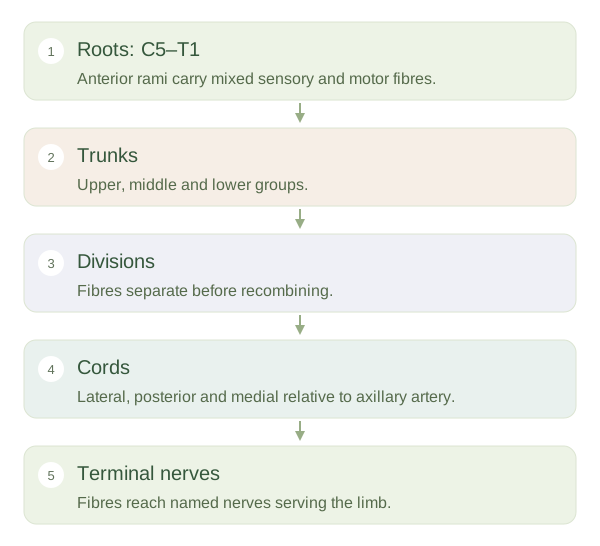
The is a network formed mainly by the anterior rami of spinal nerves C5 to T1. These branches contain both sensory and motor fibres. Within plexus terminology they are called roots, but they should not be confused with the separate dorsal and ventral roots directly connected to the spinal cord. The network begins in the lower neck, passes towards the shoulder and continues into the axilla. Its role is not to generate commands; it reorganises fibres travelling between the spinal cord and the upper limb.
Brachial Plexus — concept map
 Open diagram larger ↗
Fibres are mixed and redistributed
The main sequence is roots, trunks, divisions, cords and terminal branches. C5 and C6 commonly form the upper trunk, C7 continues as the middle trunk, and C8 with T1 form the lower trunk. Divisions separate and recombine into cords named lateral, posterior and medial according to their relationship to the axillary artery. Major terminal nerves include musculocutaneous, axillary, radial, median and ulnar nerves. A single named peripheral nerve therefore usually contains fibres from several spinal levels. Likewise, one spinal level contributes through more than one peripheral nerve.
The pattern explains injury effects
A lesion at a root or trunk can affect muscles served by several named nerves. An injury to one terminal nerve produces a different pattern, depending on where that nerve is affected and which branches have already left. This is why weakness in several muscles can provide more localisation information than weakness in one movement alone. Sensory maps also need care: a describes a spinal-level territory, while a peripheral nerve territory reflects fibres redistributed through the plexus. These maps overlap but are not interchangeable. Thinking of the plexus as a sorting network makes its many names easier to understand without memorising every branch at once.