One arterial route changes names
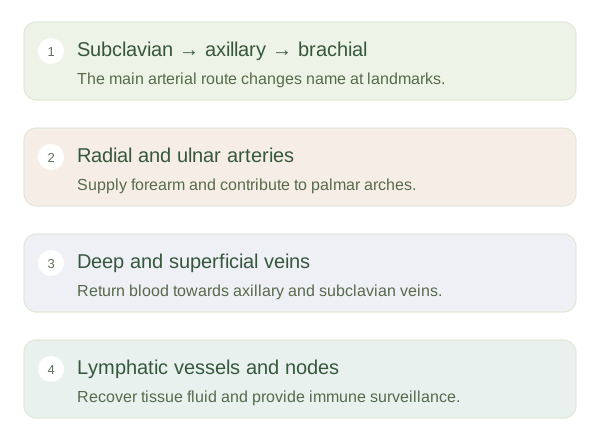
Blood reaches the upper limb through the subclavian artery. Beyond the lateral border of the first rib it is called the axillary artery, and beyond the lower border of teres major it becomes the brachial artery. These names describe successive regions of one continuous main route. Near the elbow, the brachial artery usually divides into radial and ulnar arteries. Their branches contribute to the palmar arches, which supply the hand and fingers. Connections between branches provide alternative routes, although they do not guarantee adequate flow after every blockage or injury.
Upper-Limb Arteries, Veins and Lymphatics — concept map
 Open diagram larger ↗
Veins have deep and superficial paths
Deep veins often accompany arteries, sometimes as paired vessels. Superficial veins lie within tissues beneath the skin and show considerable variation. The runs mainly on the lateral, thumb-side aspect of the limb, while the basilic vein lies more medially. The median cubital vein often connects them at the front of the elbow. These superficial routes eventually join deeper venous return towards the axillary and subclavian veins. Venous valves and muscle movement help blood return against gravity. A vein’s visibility on the skin does not tell you the complete arrangement of deeper vessels.
Lymph returns tissue fluid
Not all fluid filtered from blood capillaries returns directly into nearby veins. Lymphatic vessels collect excess tissue fluid and proteins and carry them through lymph nodes before returning them to the venous circulation. Much upper-limb lymph passes towards , although routes differ by region and depth. Nodes also provide sites for immune surveillance. Lymphatic drainage is not the same as venous drainage, even when the routes travel near each other. Impaired lymph return can contribute to swelling because fluid and proteins accumulate in tissues. The three maps therefore answer different questions: arteries deliver blood, veins return blood, and lymphatics recover tissue fluid while supporting immune function.